

(In the Winter of Our Discontent)
This is Markus. Ususally I write my ART LOOK posts on my Website here: MarkusRay.com/Art-Look . The last post I titled “What Do You See?” It was about the act of looking itself. Can we be astute in our observations of things? Any “thing?” It does not have to be a view of ART, which is what we normally assign to the more sharp-witted brilliance of our more aesthetically inclined “look.”

SEEING. What do we SEE and how do we SEE IT? Do we see what we see with preconcieved notions by which we are conditioned? Or do we truly Look with an open mind and heart? Do we see in the present, or are we doomed to be tainted by memories of what we know and how we know it? Are we ever really fresh and free to look into this holy moment that will never come around again in the same way?
We seem to be in a kind of “winter of our discontent” here in America. And this discontent is driving us to forget how to LOOK. We have already made up our minds we don’t like what we see, and this is putting many of us in a daily consternation that our country is going down, somehow, into a low ebb—a “period of decline.” Should we be concerned with the apparent clash of ideologies and party factions that govern the media mileu right now, and also the very halls and houses that formulate our nation’s Grand Experiment?
“Give me Liberty or give me death,” said Nathan Hale just before being hanged by the British in New York City on September 22nd, 1776. This is year 250. On July 4th we will be a grand old age of 250 years young. India and China could add another Zero. 2500 years of the duration of their cultures is no big deal. We, over here, are barely teenagers. They, over there, have seen it all come down. And they are still there. And the Aboriginals of Australia, primarily what this post is about, have been Stars shining in the night sky for 65,000 years that we know of.
THE BUR OAK THAT SAW THE BIRTH OF THE USA
Yet, time is a sleight of hand. Real seeing has nothing to do with it. The ever present now is all there is to look at, and it suffices. Meeting Life in the present is the only meeting that has real meaning. And even when we meet some “left over” from the genius of past endeavors, we meet it here and now. And this is what I did last Friday. Before the snows fell here in Washington, I did my “bike morning” up to Capitol Hill to visit my favorite Bur Oak Tree which was planted around the time of our Nation’s Birth, 250 years ago.
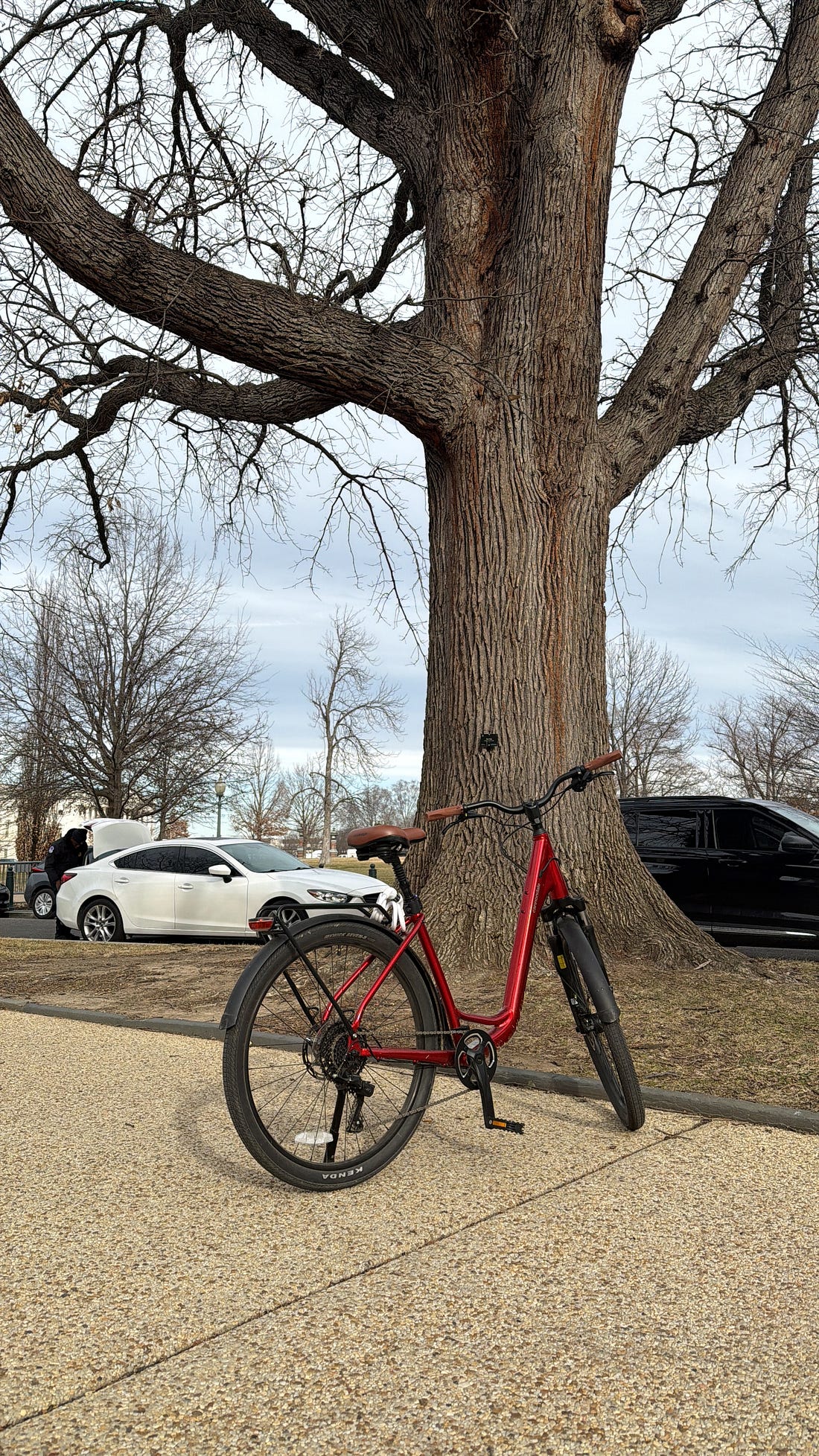
| Bur Oak and Bike Near the Capitol |
It was a cold day, and though I was well bundled, taking my full ride to the Lincoln Memorial would have frozen me to the bone. So, I opted out of that, which led me to a different and more fulfilling free-flow of my regular Washington meander.
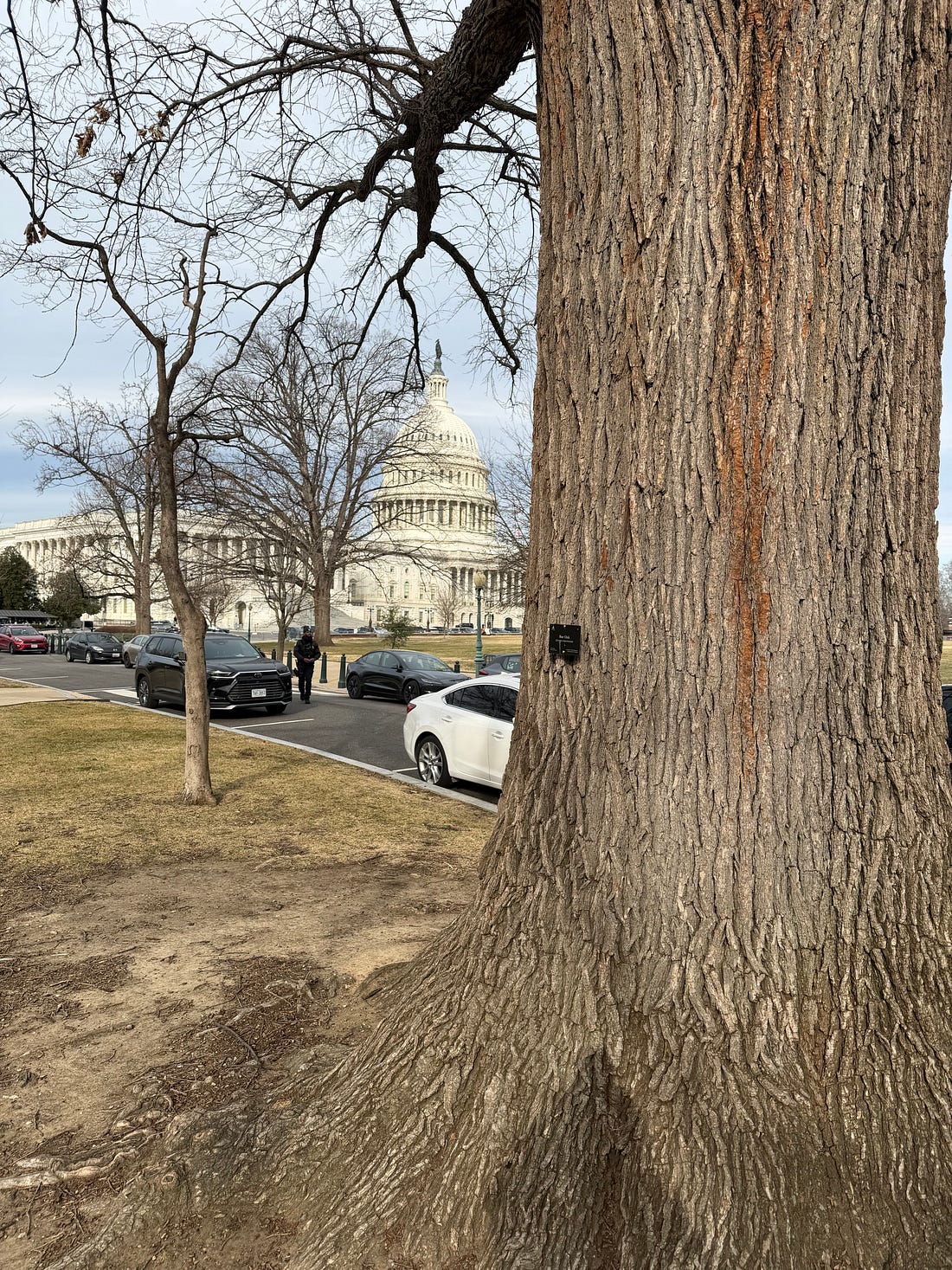
| 250 Year Old Bur Oak |
Earlier in the fall I picked up a bag of bur oak acorns. Impressive indeed. Hard to believe the life of this huge tree was contained in this dinky seed. How many thousands of years this bur oak family has been feeding a lineage of Great Sintenels into our bless’ed world, with their majestic presence. Their force is an unrecognized grounding, usually in places most needed—like across from the US Capitol where all the debates of worldly affairs are “hacked out.”
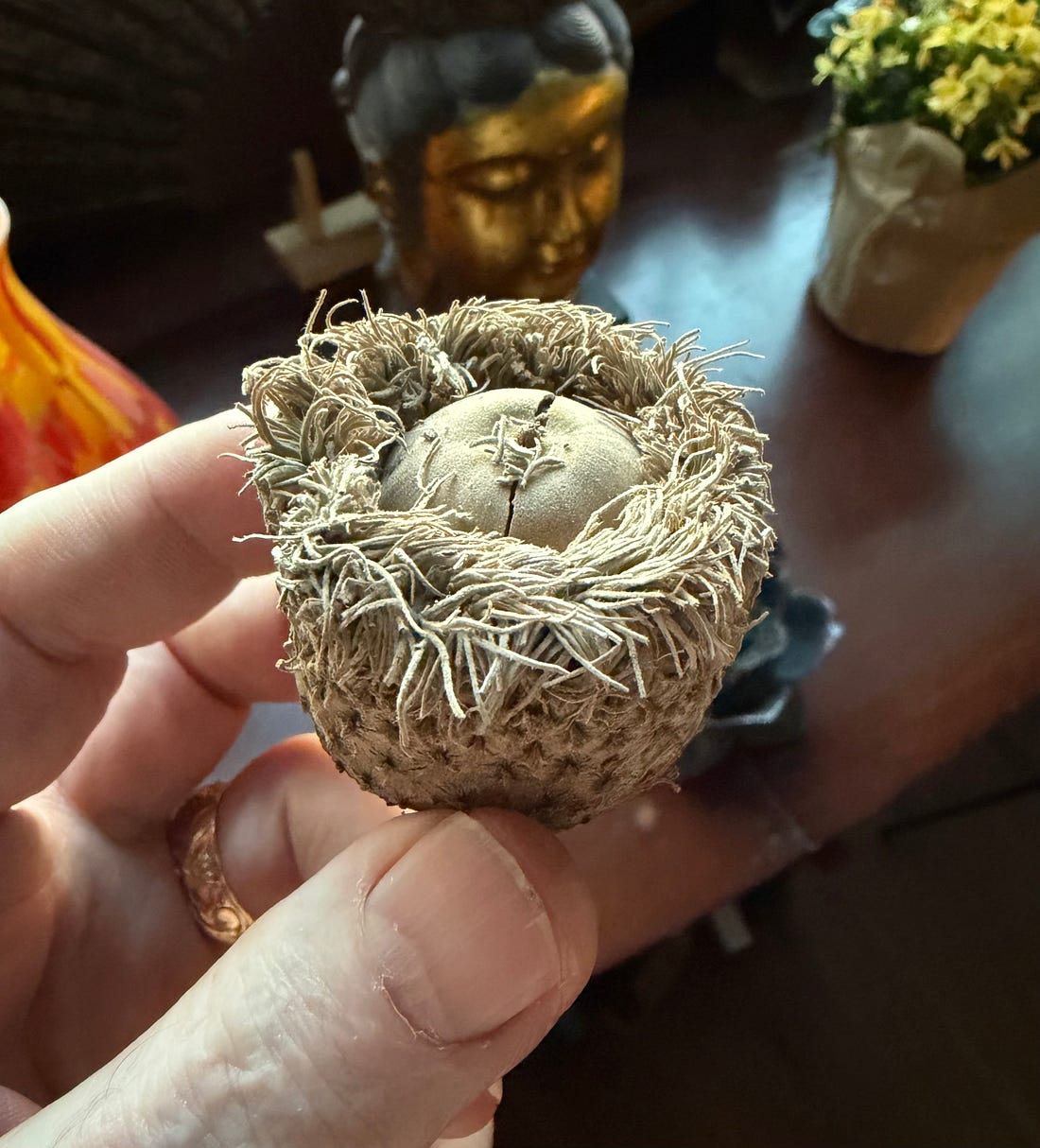
| Bur Oak Acorn |
When I got down to the Mall, I shortened my usual route and diverted over to the National Gallery of Art. Many policemen and barricades were set up. ??? Apparently some march on Washington was scheduled to protest the recent violence involving ICE and immigration issues. But, I managed to navigate through the cache of police cars as I entered the National Gallery approach. I parked my bike and locked it up, then proceeded through the door to the West Building—where the traditional paintings and scupltures that are so inspiring to me are primarily housed.
ART IS THAT WHICH ELEVATES OUR SOUL
One could say on this winter day, that as long as we have Art the doldrums of our discontent are held at bay. Always then, we can feel the love of something greater than ourselves palpitating through our veins, and the beauty of nature can come rushing into our souls to ignite the fuel of our holy fires inside of ourselves. The Art of nature does this, obviously, in the Bur Oak, but then the Art of a man-made nature can do this as well—with the magic of transforming our mood from emotional dullness to a elevated eschelon of cutting edge glee.
I walked through some of my favorite galleries in the West Building and was not disappointed, nor stuck in the winter of discontent.
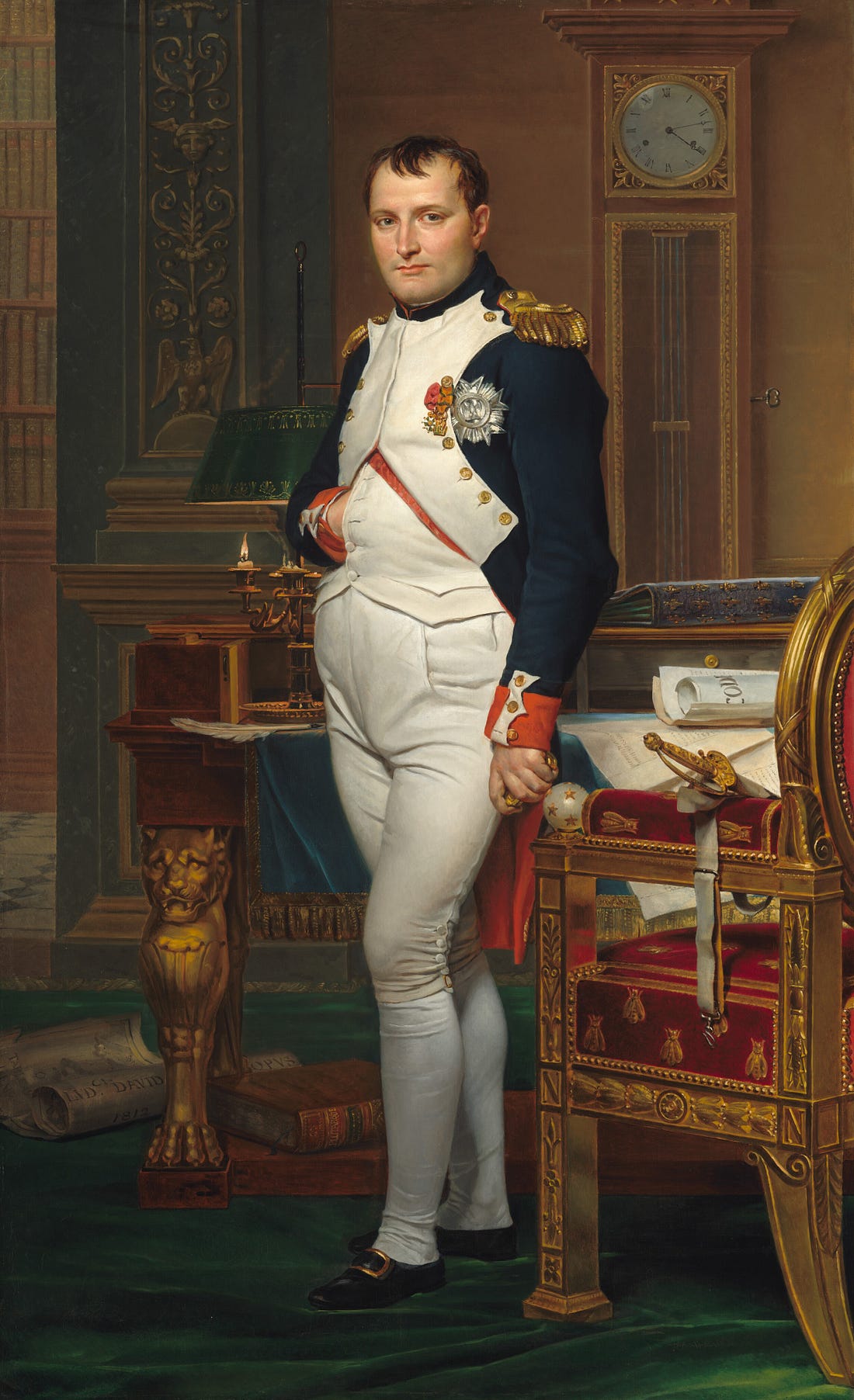
| Napoleon by Jacque Louis David |
In the Gallery that usually houses David’s “Standing Portrait of Napolean,” one of the best paintings of Napoleon in existence, the absence of this painting for some unknown reason—in restoration or on loan to another museum’s special exhibition—continued to perplex my soul. Whatever you think of Napoleon and his megalomaniac character, the portrait of him by David is exquisite. And it is still not there—but rather somewhere else shining its light, or in some conservator’s workshop getting a good cleaning.
I was a bit crestfallen I could still not see Napoleon in the flesh. Yet in the same Gallery, a painting by one of David’s students or followers caught my eye. At first glance, the “Portrait of a Young Woman in White” seems straight forward and innocent enough, but after gazing at her for a minute or two, I could not help but notice the sensuousness of the scene. Her breasts and nipples showing through the chiffon upper portion of her bodice are bound to arouse even the most chaste onlooker. And those broad bovine eyes with a far-off bedroom gaze are enough to invite the unsuspecting viewer into an encounter with her vulnerability—that entices us into her unseen boudoir.
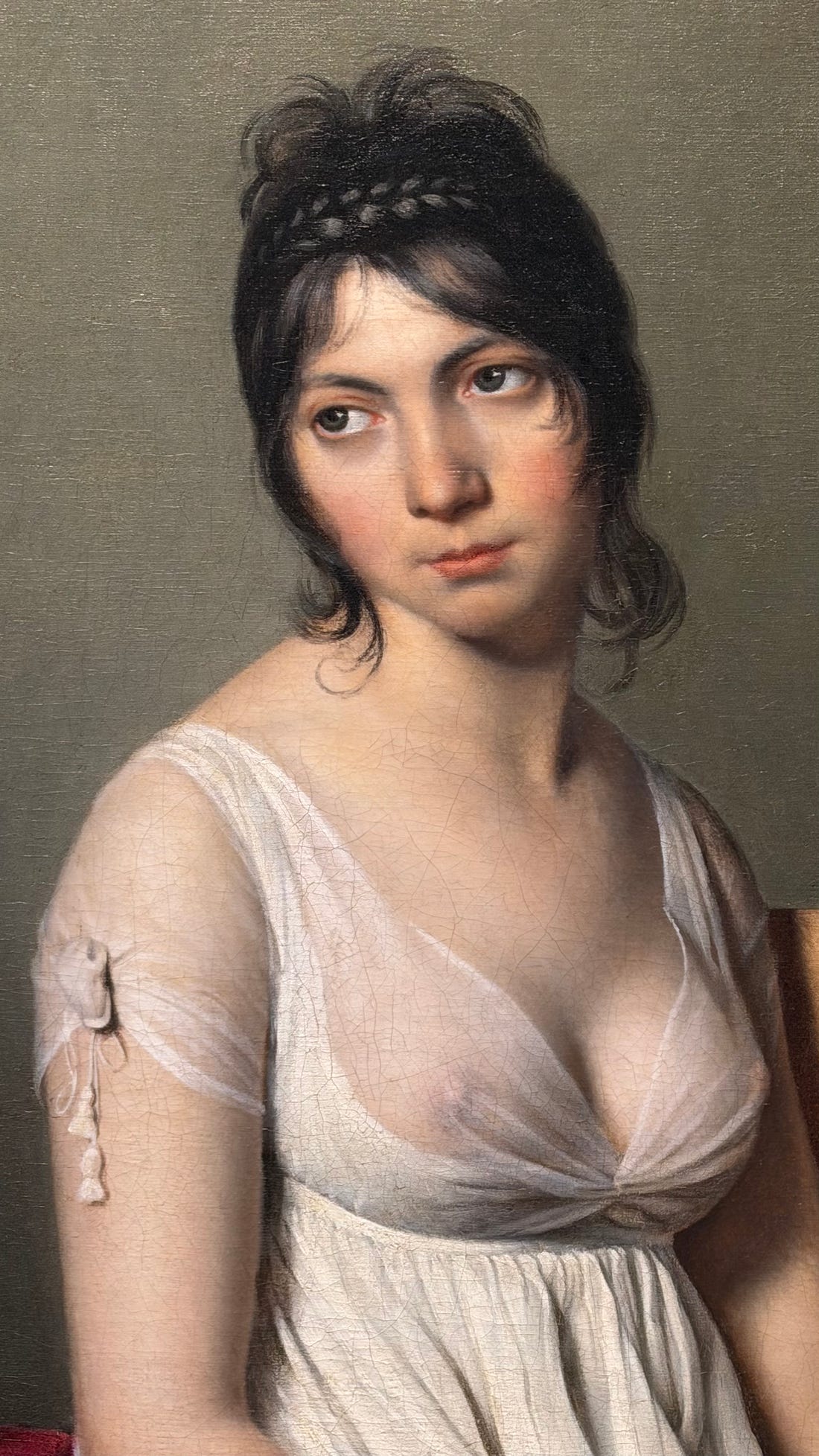
| “Portrait of a Young Woman in White” |
All this is done in paint, mind you. No photography. No special media tricks of the trade. Just an encounter, put down in thousands of brushstrokes and the astute ability to paint what is seen. We are taken there in this moment. As the “winter of our discontent” is dissolved, we are given a blessing. And the Joys of the flesh are intensified in the most innocent quarter of our graceful observations. My soul was definietly elevated, and the core of my manhood aroused.
AN ENCOUNTER WITH THE UNEXPECTED
The best encounters in life are the ones we do not expect. The East Building houses the 20th Century and Contemporary collections. To get there from the West Building, one goes down to the lower floors and passes through a long undergroud corrridor, I call it the “tunnel,” that connects the two buildings. A couple book stores are along the way, and sales of art reproductions, and a wide range of tasteful art products—wearable and of the nick-nack sorts—are on sale. On the way is a glass panel wall that is activated by a cascade of a waterfall from above. One must walk past this cascade on the way to the “tunnel.”

The unexpected surprise of emerging out of the “tunnel” into the East Building of the National Gallery hit me for a loop. I was stopped in my tracks when I saw this banner at the entrance of the Special Exhibition Hall, just as I came out of the underground passage.
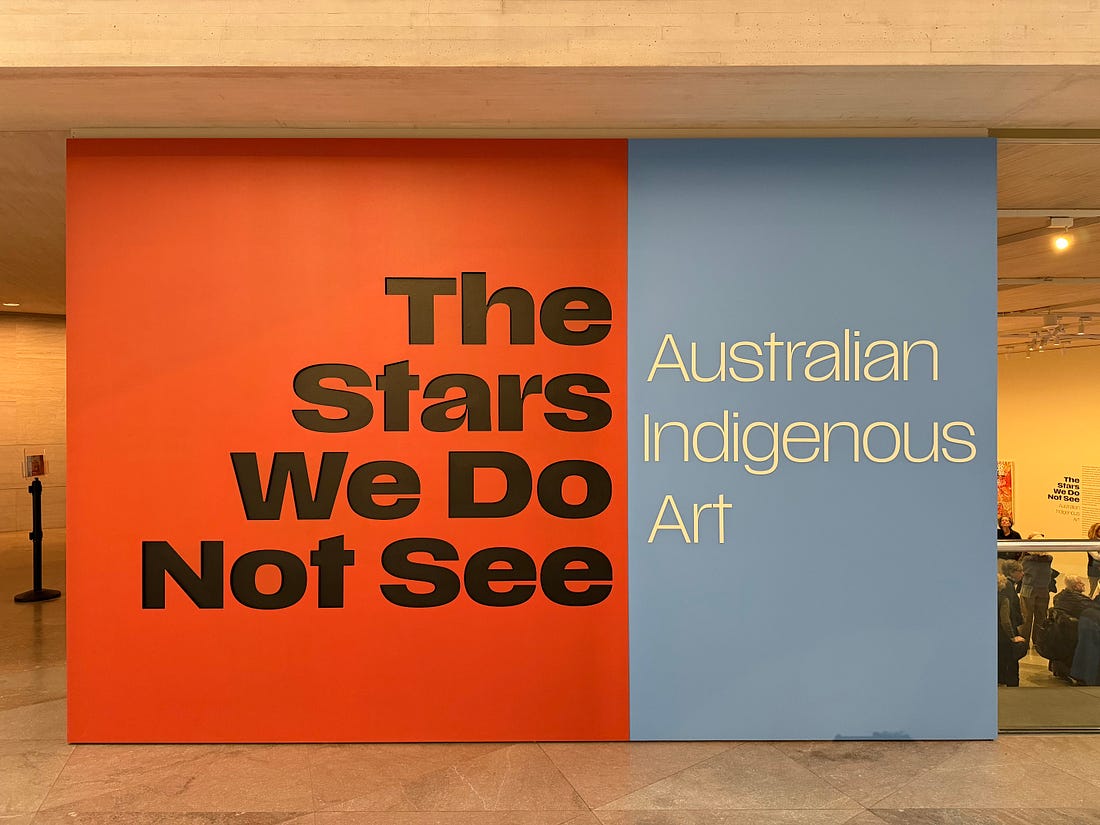
| Exhibition Banner |
I was face to face with a new exhibition: “THE STARS WE DO NOT SEE: Australian Indigenous Art.” A bold move on the part of the curators, to say the least. We have been to Australia many times, and though I was a little aware of some of the Aboriginal Art there, nothing prepared me for what I was to see next.
THE STARS WE DO NOT SEE
Mind you, much in the same lines of the USA’s “manifest destiny” policy to establish a nation coast to coast, without too much regard for the indigenous people aready living on the land for tens of thousands of years, Austrailian settlers from the Western world had much the same attitude. “Take all the land becasue it really was not ‘inhabited’ by anyone significant.” Indigenous people were relegated into the class of “non-entities.” And their cultures were seen as backward and uncivilized, therefore, justifiably pushed aside as insignificant. Why pay any attention to the stars in the sky, when we are focused on grabbing all the gusto we can get by optimizing our claim to the land we had already deemed empty for the taking, and uninhabited by real humans like us?
Like most indigenous peoples, the Aboriginal tribes of Australia lived in harmony with the land. Mother Earth and Father Sky took care of them. They did not build elaborate cites because they did not need to. In a kind of Eden already, why turn paradise into something that required incessant labors to maintain? Why portion off the country in “plots of ownership” when the whole universe belonged to God anyway? And God takes care of us in natural ways that require minimal to no effort. The Aborigines were content to be taken care of by the elements. Living on the land in harmony, they developed an Art Form that reflected this existence of natural ecstasy.
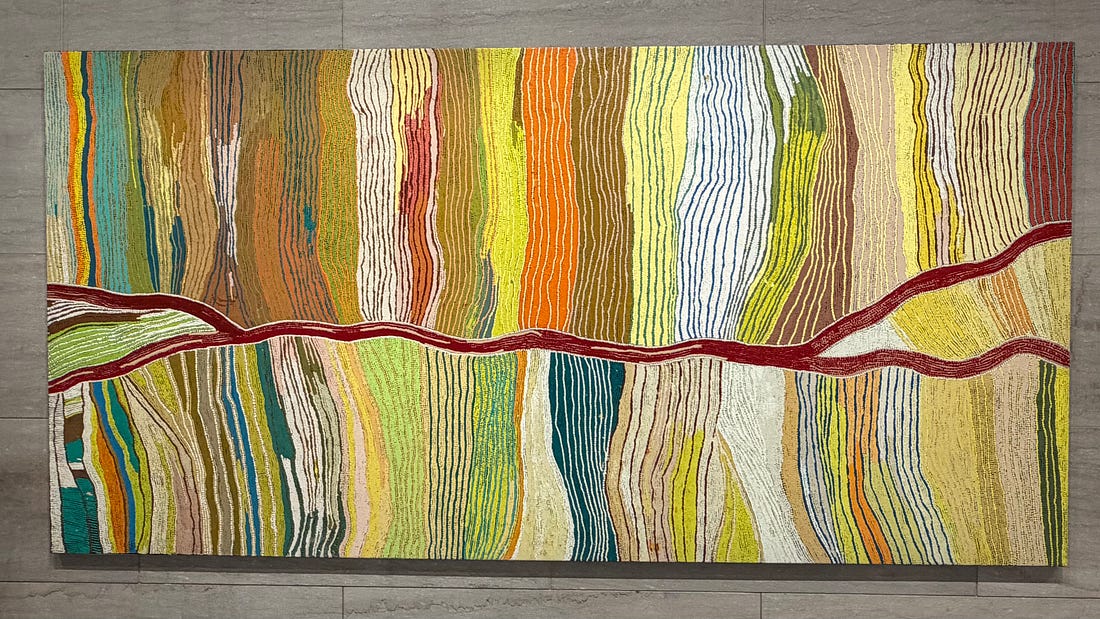
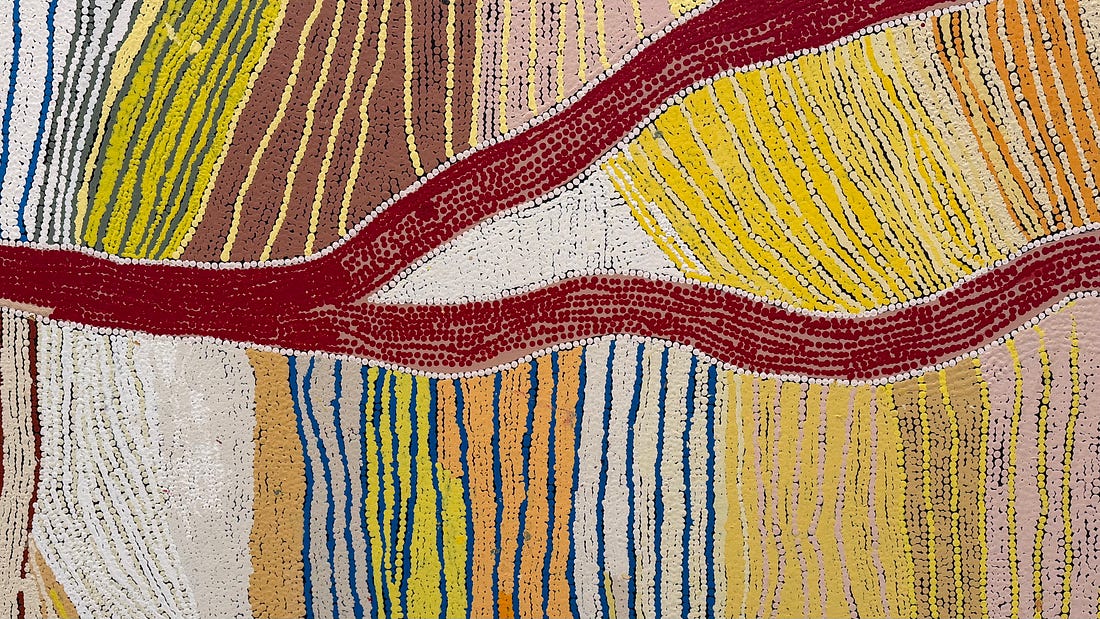
THE STARS WE DO NOT SEE opened my eyes WIDE AWAKE! I had an epiphany of sorts. Many of the paintings, large in scale but minute in detail, transported me to realms of deep connection with the land, the color, and the fervent force of life pulsing through the artisans of these ancient and wise people. How uncivilized we have been in our treatment of Indigenous Folks. More aware than us as to the workings of nature and our place in it, these STARS made their presence know in this exhibition at the East Building of our National Gallery of Art.
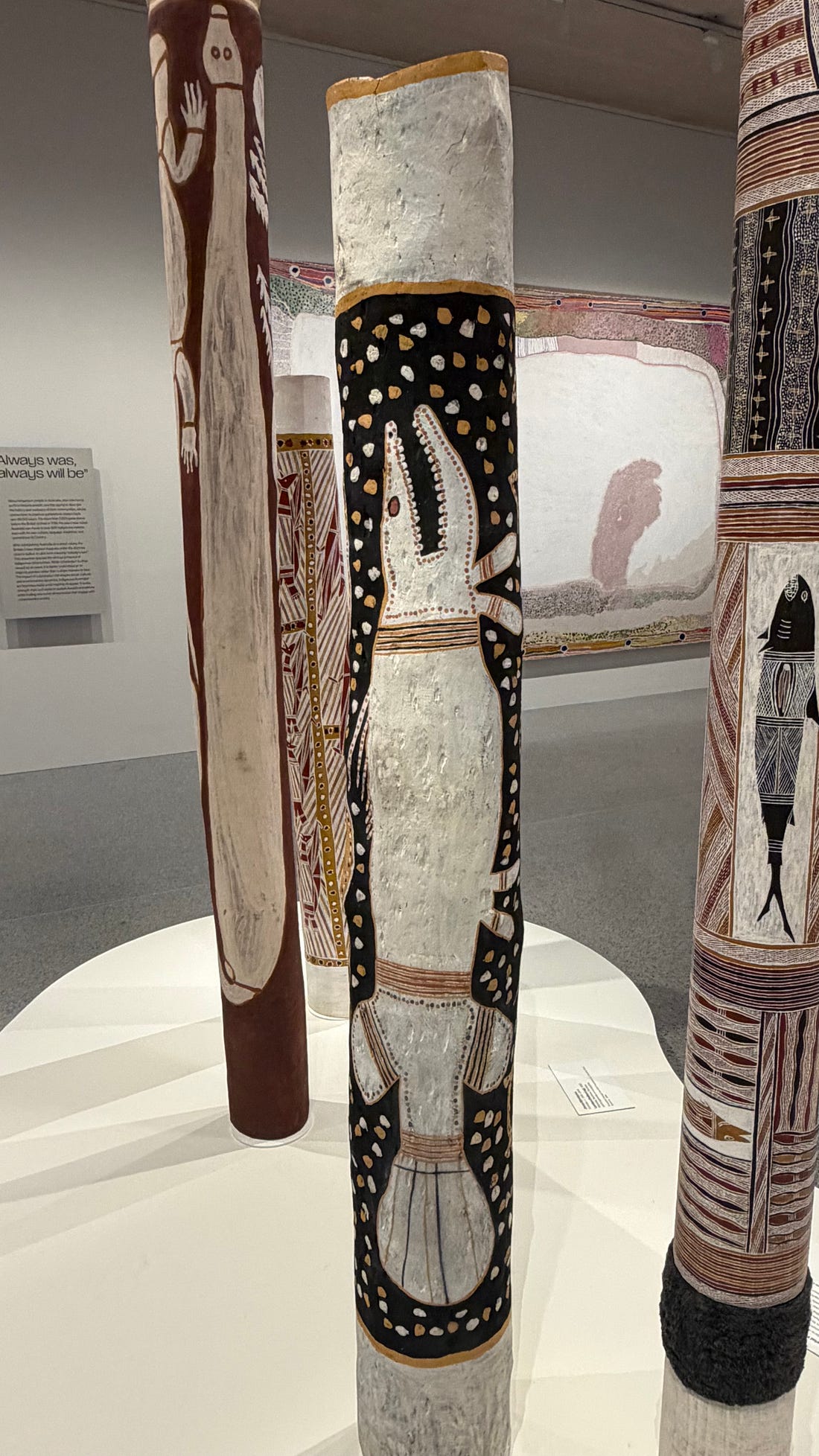
Posts of Power permeated the exhibition. We could say the artisans were shamans—those in touch with metaphysical forces pulsing within the very physical objects and beings we encounter in our natural world. A fish is painted on a tree trunk. It becomes a “totem pole” of sorts—a pillar of procreation. These sensitive artists ensure the continuity of what sustains them by honoring its presence in these objects of great reverence and sensitivity. They form replicas of the things in their palpable existence—the things in their day-to-day lives—by paying homage to their presence through essentail marks, images of animals, gestures of their painting metrics, and even graphic constructs that hold them and their subjects in a place of sacred respect.
Can we make an art form of the very elements of our natural world that sustain us, and be uplifted in the meantime with all the light we could not see before? A molecular structure is revealed in a freely formed way in these works—and the matrix of the “dot” is elevated into the realm of the holy.
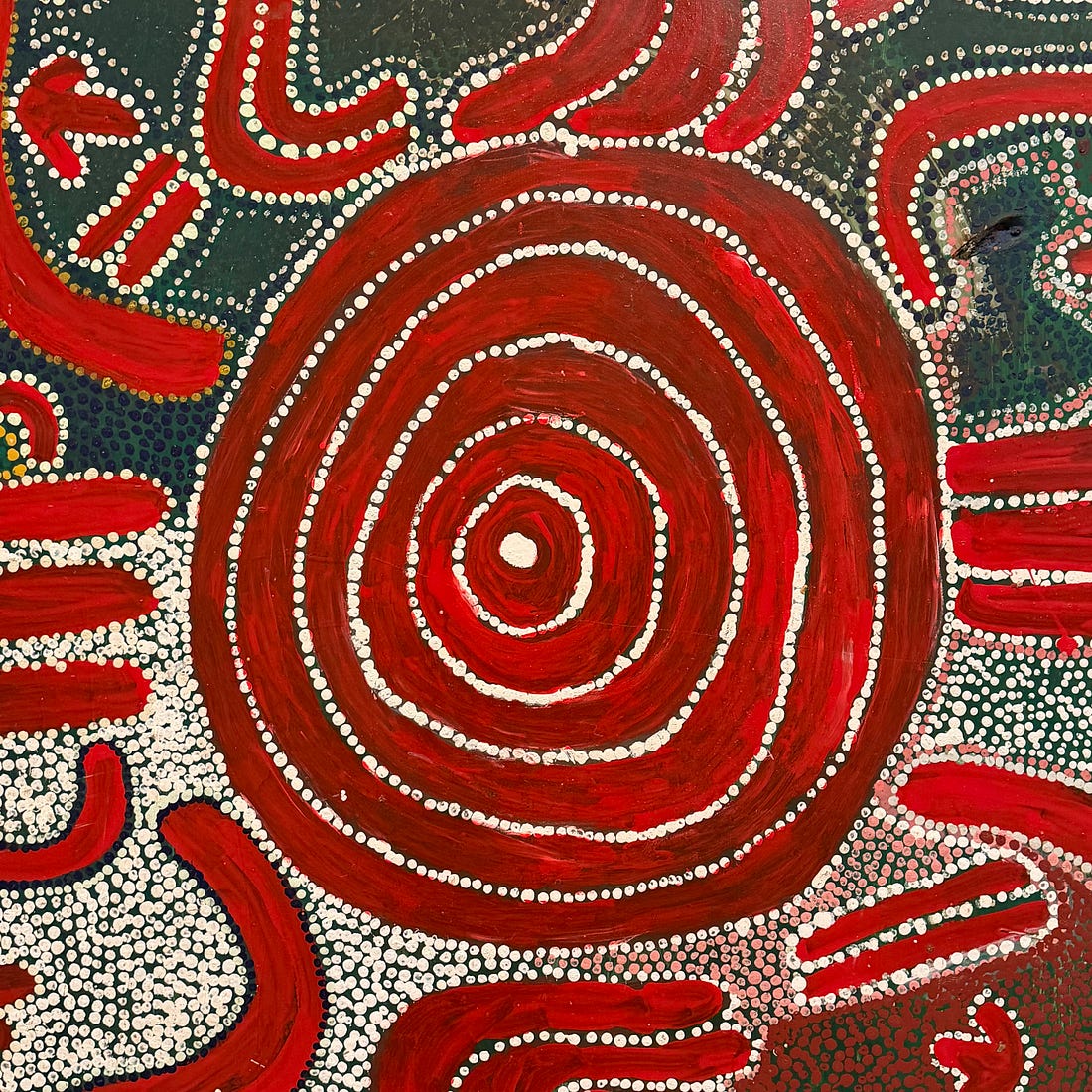
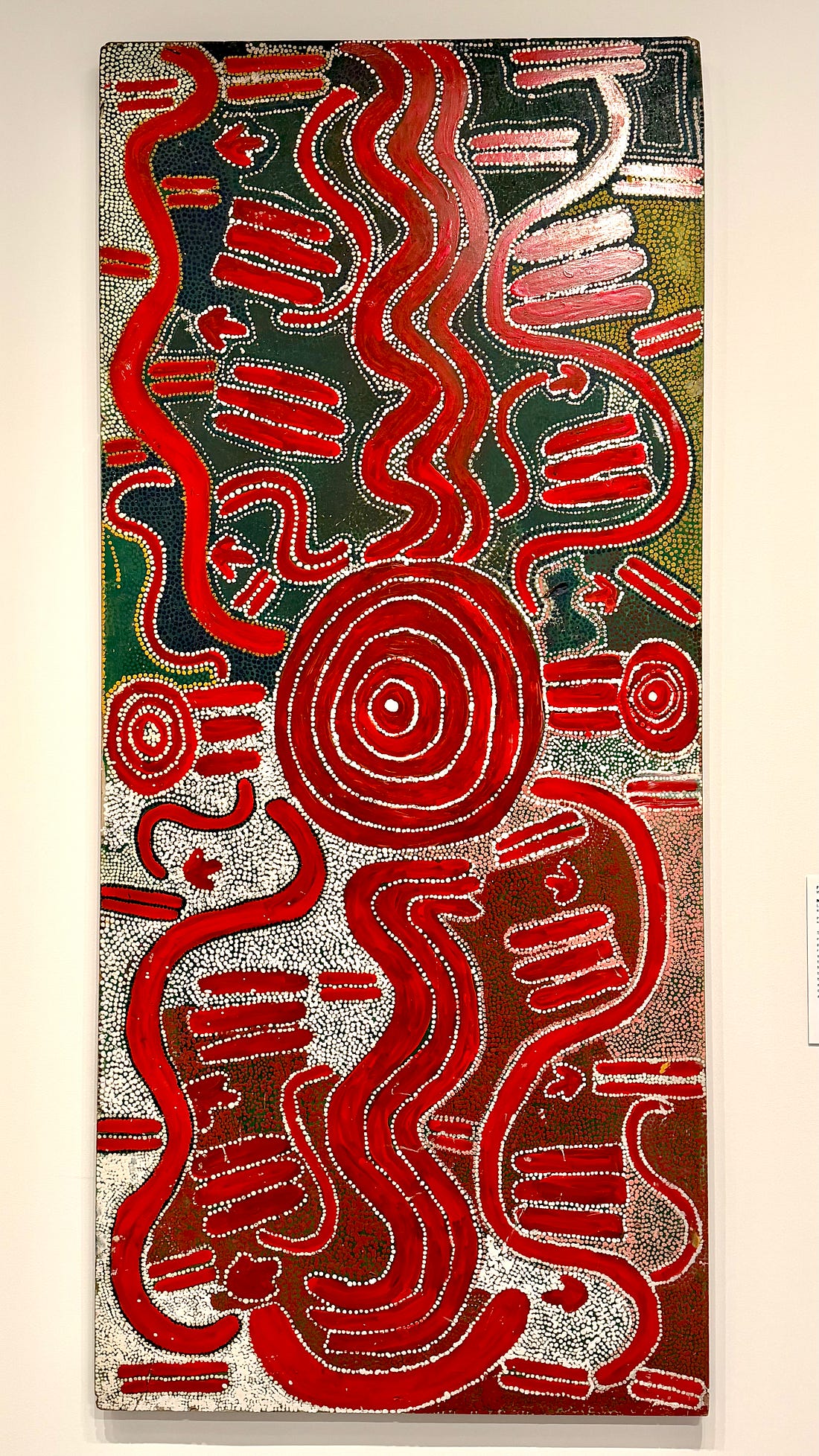
THESE “THINGS” ARE LANDSCAPES
You could say a bird’s eye view of a place, plotted out in detail, could be a useful map. And you could say a map is a type of a landscape. And you could say the surface of a painting is a kind of a map into regions of the heart and soul that reveal something remarkable and wonderful, never seen before in the same bold and illustrious fashion.
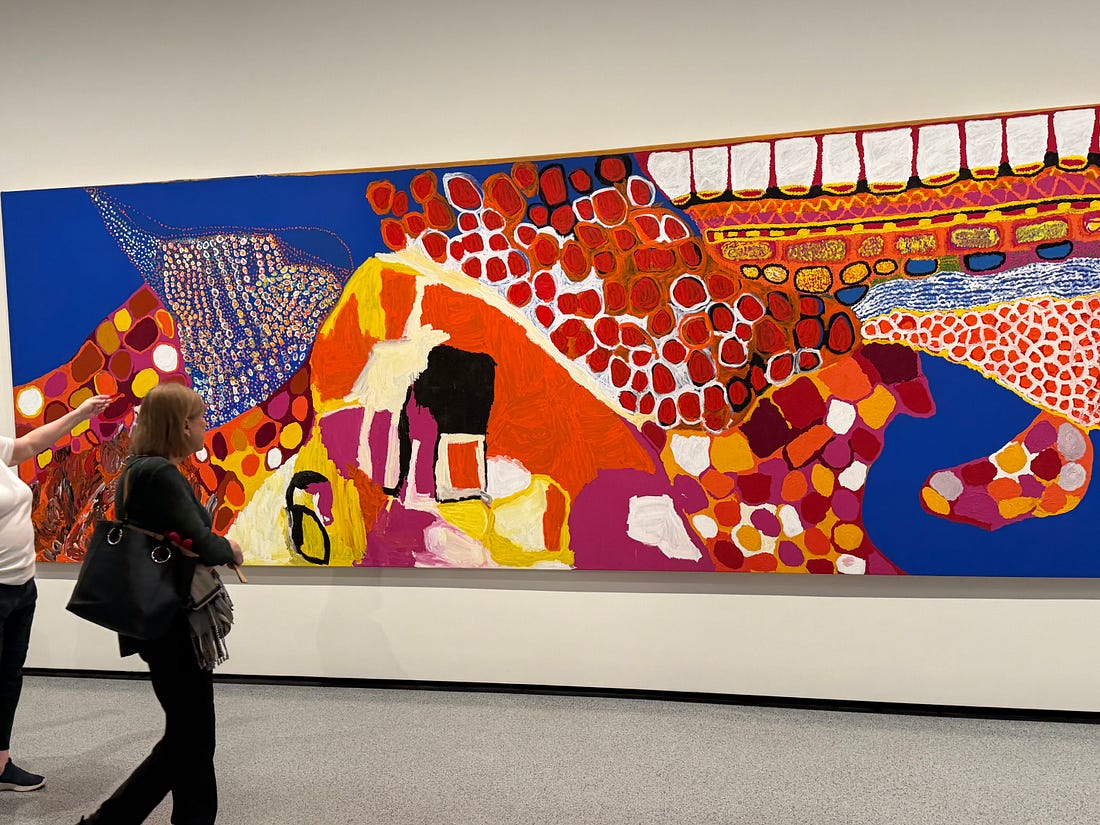
These “Things” of the Aborigines from Australia are such power vortices of connection that even the most uninformed and unschooled “Art Looker” can relate to them. These “Things” have been made with a passion and a sense that something universal is being revealed through them. These “Things” are a kind of psychic landscape—a rainbow blast of Pure Joy that has scarely been seen in any other “ism” in the history of art. To one of my fellow exhibit attendees who was in an equal awestruck rapture gazing at these “Things,” I said, “These paintings put Abstract Expressionism to shame.” The Abstract Expressionist movement in New York in the late 40’s, 50’s and 60’s was simply “child’s play” compared to these Aboriginal blasts of cosmic brilliance.
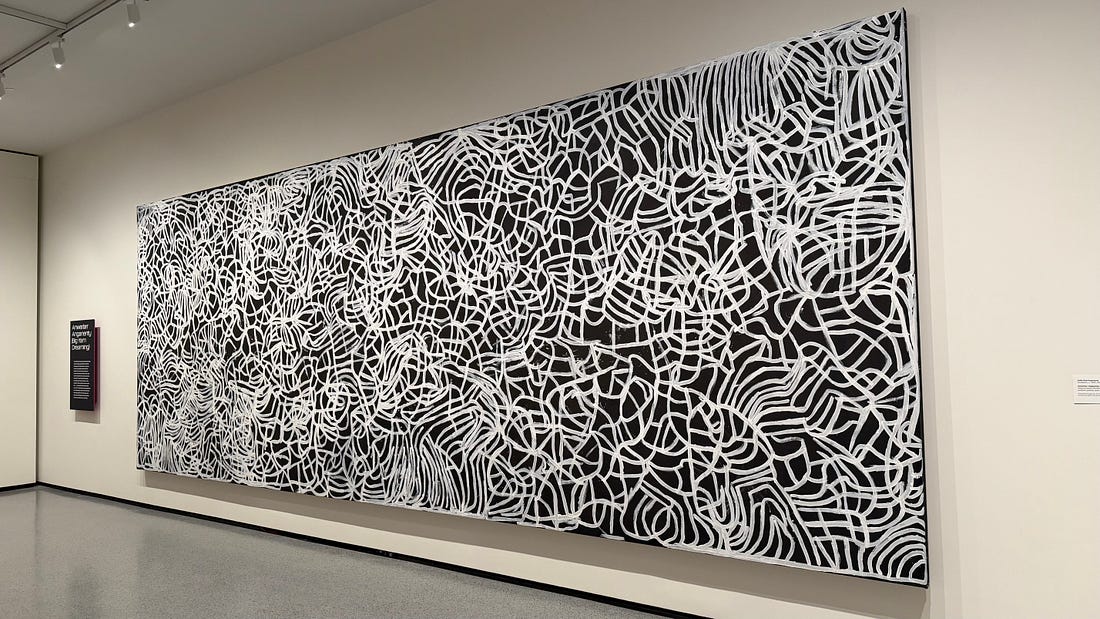
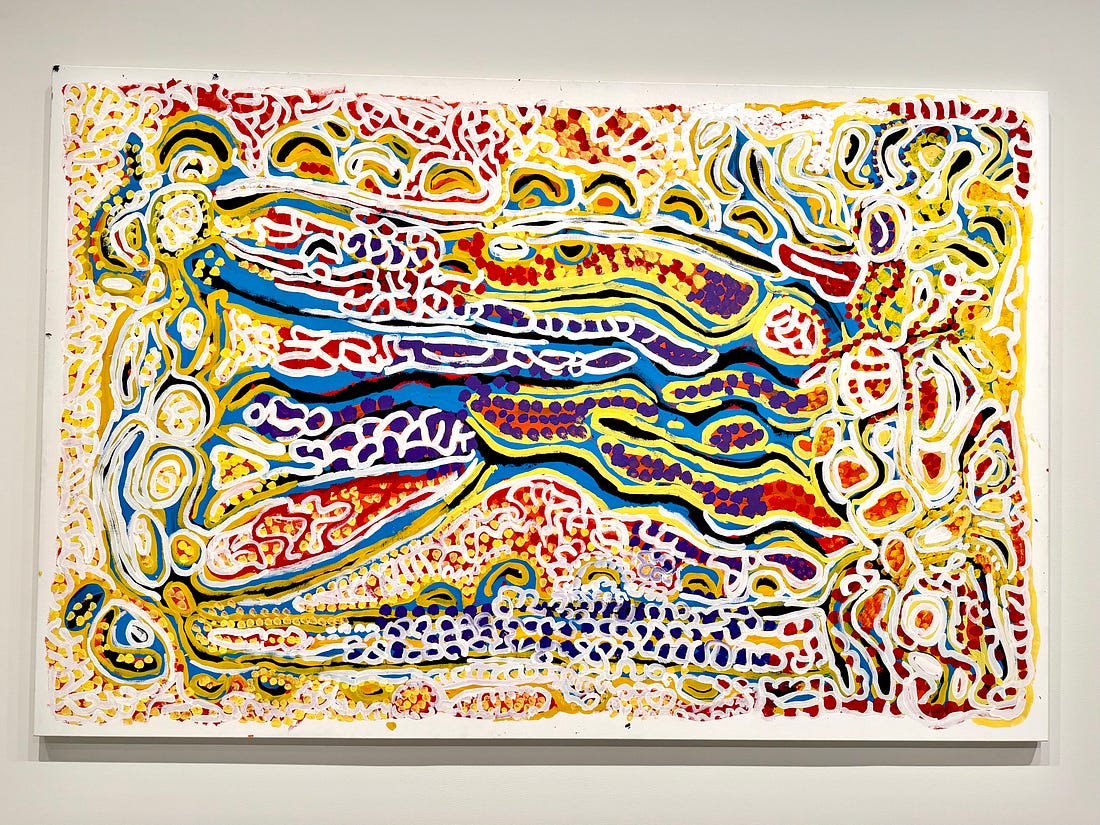
Mind you, most of these paintings are larger than life. Ten or even twenty feet or more wide, and eight or ten feet tall. They create an atmosphere into which one must enter and be engulfed by the fervent and impassioed expression of the painter’s Love of Life itself. There is no “rebellion” in these works, no “me agaisnt the world of existential positioning.” These painters have nothing to prove. The paintings are a pulsing, a breathing, a beating of the immortal heart of loving that makes them one with the universal Life Force that spawned them. The Aboriginal artists ARE PURE LIFE in the flow of seemingly endless gestures of visual affirmation. These Paintings and Objects they created ARE LIFE as well. They are not “about life,” they seriously ARE LIFE. There is no “gap.” There is no intellect involved. They are pieces of nature that “culture” put together, and then removed itself from any “credits” that would detract from any pure encounter with the power of nature emanating out of them.
THE STARS WE DO SEE NOW
The prerequisite for true “seeing” is to admit we have been blinded by our own conditioned ways of seeing in the past that blocked our true vision in the first place. The Stars “we did not see” before were only because our gaze was diverted toward the blind spots of our belief systems of prejudice, personal inclinations, and unwillingness to approach the Unknown with a reverence worthy of new discovery. We have to be people of the light who move toward the Stars, and often this requires redirecting our starships past all the familiar places, past the planets of our solar system, past our place on earth, in this small body of flesh and bone, into another realm of divine perfection. Divine perfection is always there, but we are absent.
In the present is the opportunity to SEE. And it is best to approach this meeting with the present with a mind that is empty. On a cool cloudy day in Washington in January, well intened to bike my way “down the Mall” to the Lincoln Memorial, I got redirected by the Divine Forces that wanted me to see these true Stars of the Aboriginal Cosmos.
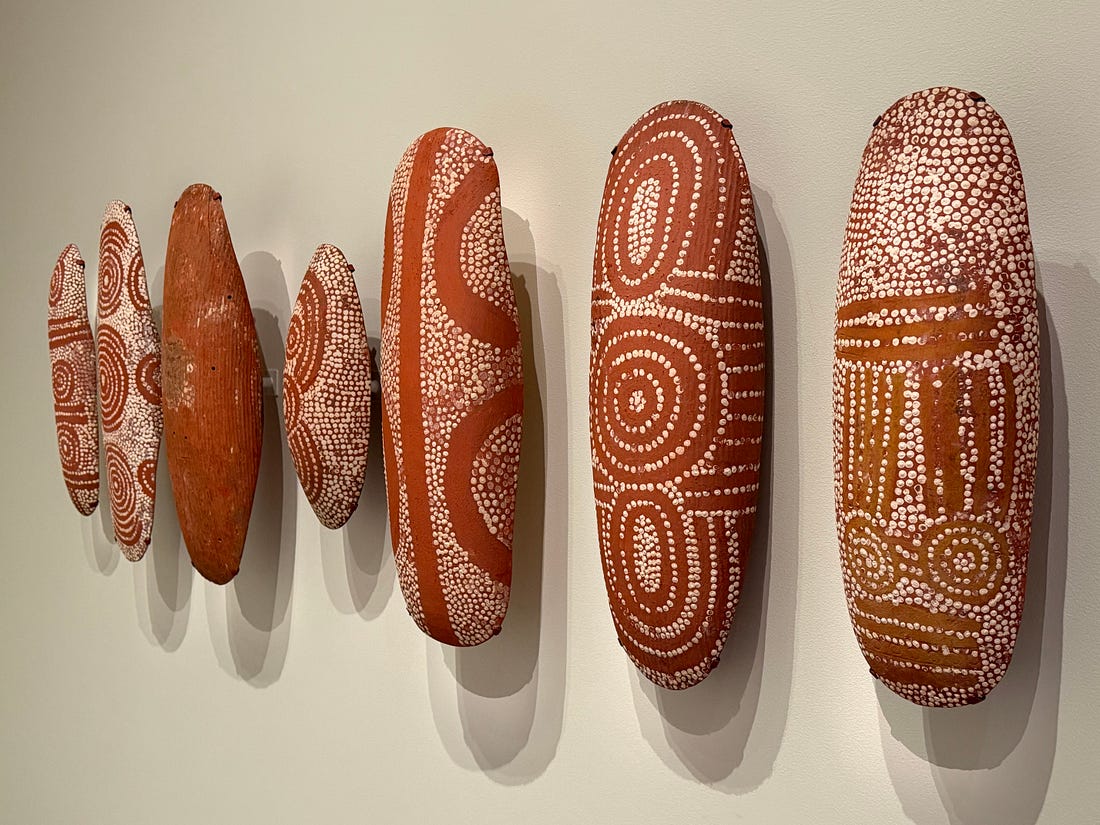
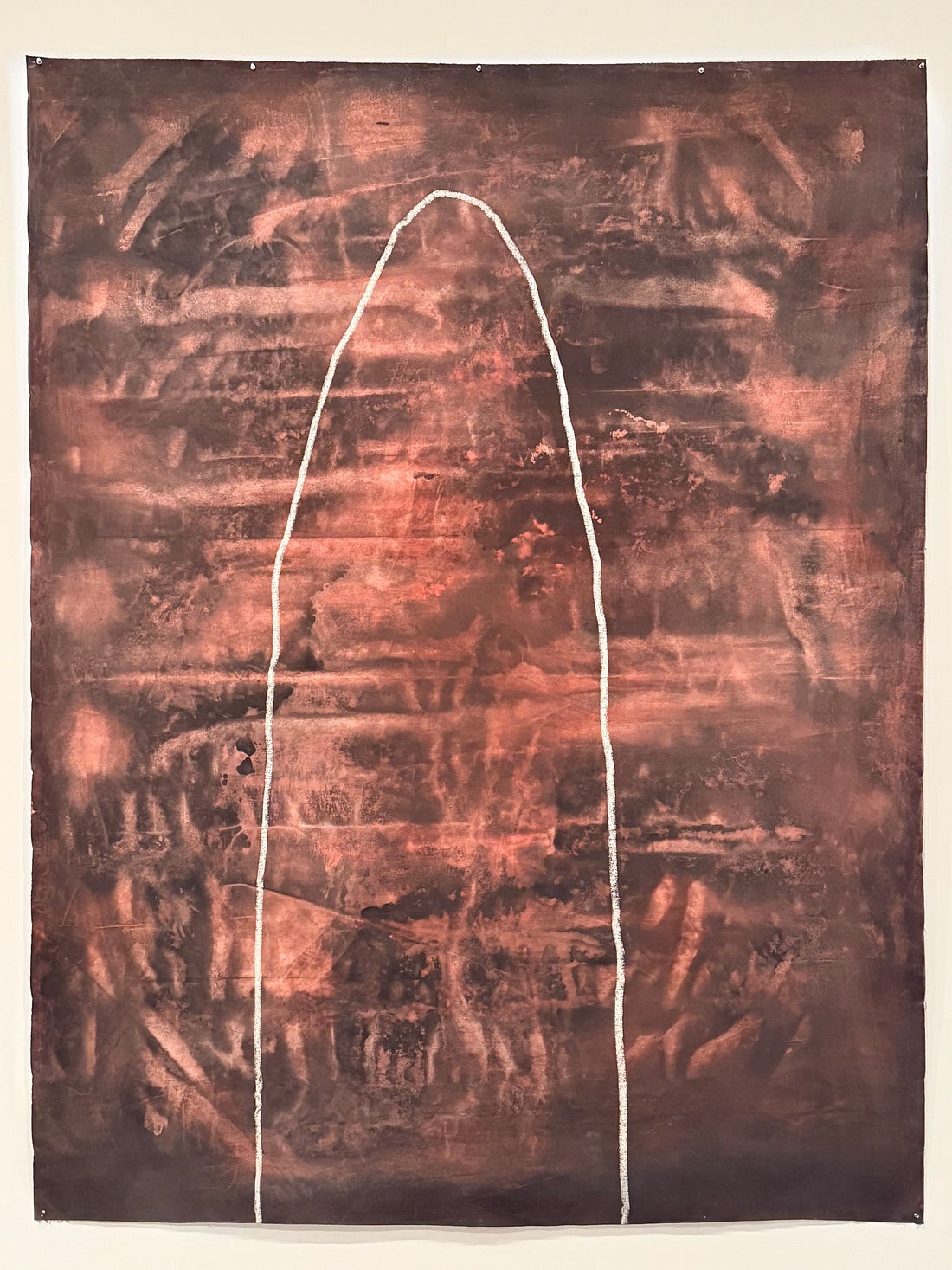
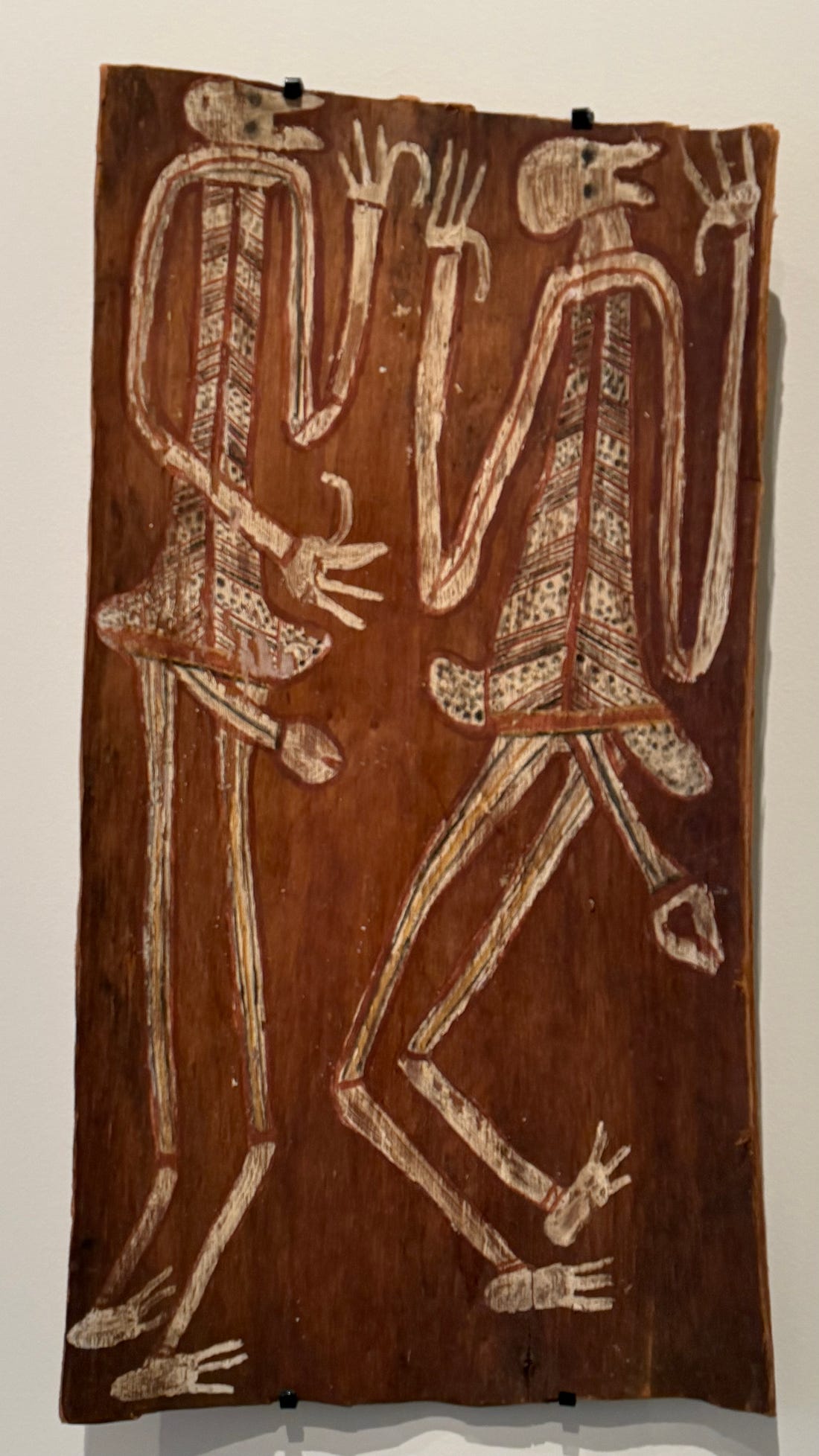
This unabashed encounter with a visceral response to an instictual world of “life here on earth” is what I blundered into, unexpectedly, on one of my Washington Bike Rides. Letting it all hang out, there is an assertion in this body of work—called THE STARS WE DO NOT SEE: Australian Indigenous Art—that came off the objects and entered my whole regenerative world, transforming my very “way of seeing” painting and sculpture into something transcendental. My encounter with this work was not “about the stars,” but rather showing the stars in their actuality—the constellations right before me. From the hands of these Wise Ones of Down Under I was shown that great painting does not always travel along the lines of Western Art cannons and conditions to reach my innocent eyes. In viewing these masterful works, my observations are unexplainable, so vast are their proportions.
There is a meeting with eternity in these paintings and objects, and the cycles of Life are honored. A mode of being is transmitted by these modern day Aboriginal masters. The Stars are revealed. We would stay blind to not direct our gaze toward their light, even if it took years of traveling through space to reach us.
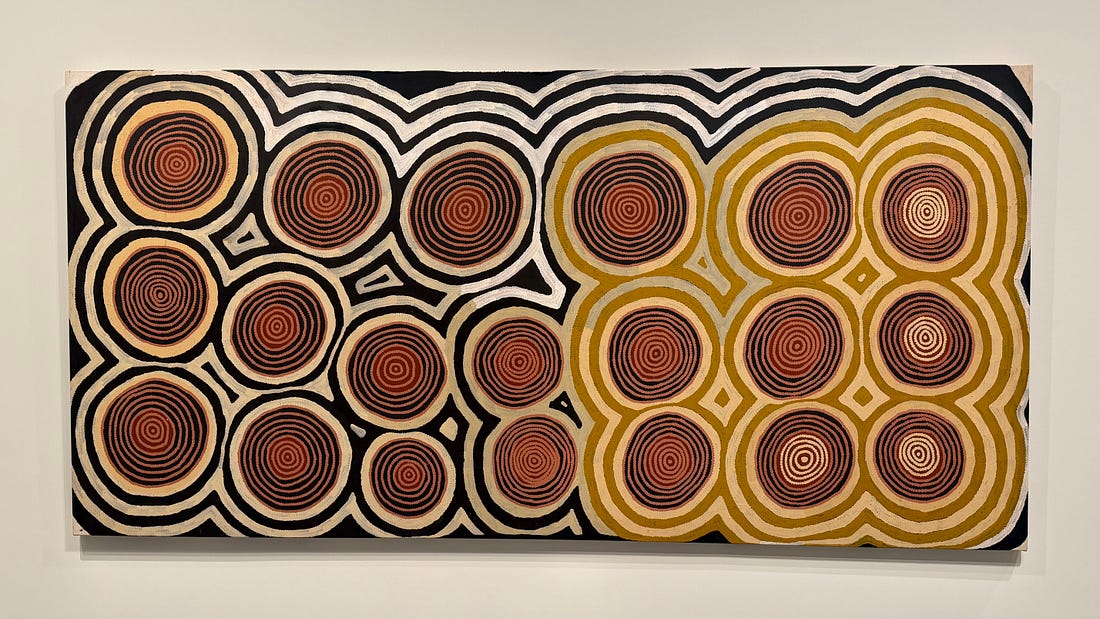
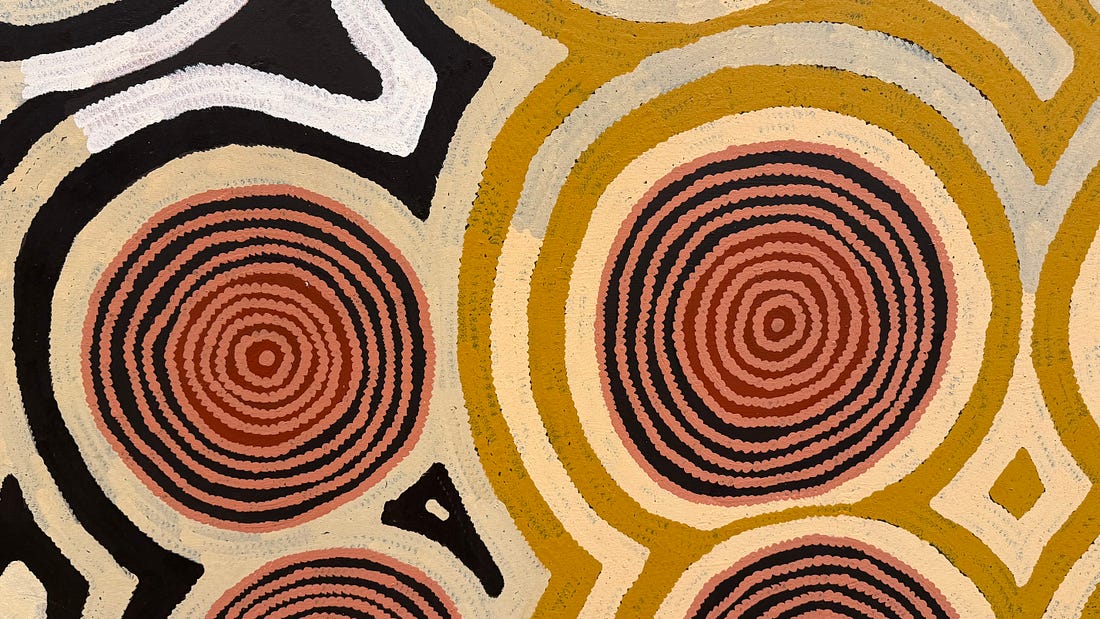
The Light has come, and I am glad. I have forgiven the ways I saw before, which one could question, “Was that ‘seeing’ at all?” There is a new dawn in my world of Art—painting and drawing in particular. I can see the Stars now. I look toward the Sky, and the Earth, for the integration of my existence for this new period of revelation.
I can be still, and let the earth be still along with me— and be guided. I can have certainty that my generative impuses are not lightly taken, never wasted, but given the force of the Cosmic Creativity behind them. Aspira Astra is the Latin phrase for “Reach for the Stars.” That I will do, in full view now, thanks to my Aboriginal Brothers and Sisters, the “Stars” we have not seen before in full view, because of our false sense of Western superiority, but whom we definitely SEE NOW in the cosmic outpouring of their unbelievably wise vision.
This show is worth a Special Visit. You may want to see these Stars as well.
Tuth, Simplicity and Love speak through them.
Warmly, —Markus Ray
This Substack is reader-supported. To receive new posts and support my work, consider becoming a free or paid subscriber.


