Attention Finds Beauty Everywhere
In The Age of Images
The iPhone has revolutionized picture taking. I have nearly 30,000 images now stored up in my 3” x 6” “smart phone,” and about 3000 Videos. It’s almost overwhelming to keep track of them all. A good portion of them are of paintings—the art that has inspired me over the years. In scrolling through some of these groups of pictures and seemingly disparate collections from days gone by, I said to myself, “Where ever your cursor lands, this will be the next Art Look.”
It was not a “random” act of searching, but rather a deliberate act of “divining” to see what the “rod of revelation” would give me as tidbits of a very precise and activated Art Look—not necessarily of my preconceived making. Random is not “random,” in this case, but rather where “God would have me go.”
What would God show me in this “age of images” amidst the cache of cumulative collections of paintings and drawings I have amassed over the many years of visual storage in my iPhone? Well… here we go.
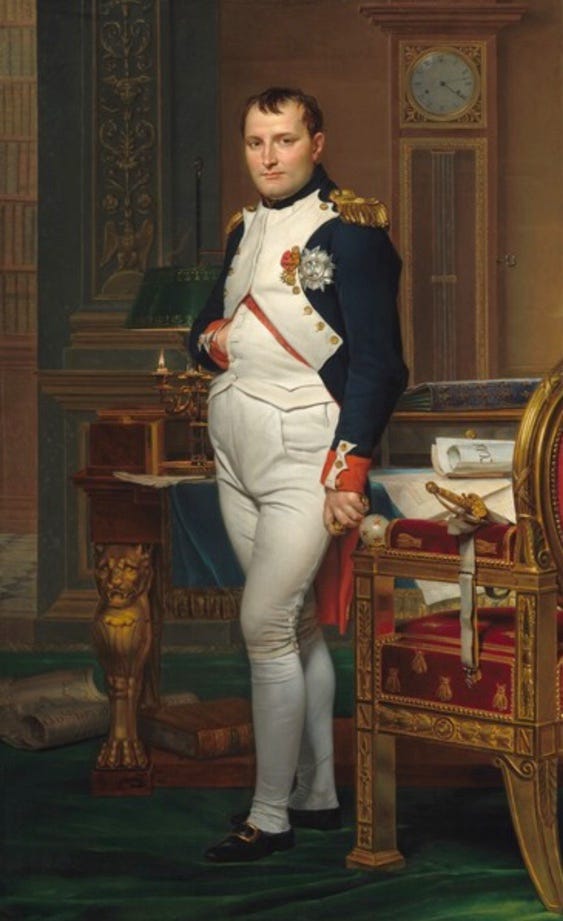
At the top of this conglomeate of compositions emerged this painting of Napoleon. Jacques-Louis David was in the thick of times, the best and the worst, of the French Revolution. He had not only a command of paint, but he had a command of the classical mode of presenting only the perfection of whatever scene or personage he was depicting. And… he had political access to the French upper class. He was in demand. We see everything in high definition, fit as a fiddle, cleaned up versions of the subject at hand—especially in this standing portrait of Napoleon in our National Gallery of Art.
I have walked by this painting a hundred times or more, and am always astounded by its presence. It is as if I could go right up to this person who swept Europe like a storm, and have some kind of meaningful exchange. He lives and breathes through David. Romaticized of course, but none the less present in all his glory. Mind you, the professional painter in this day, certainly at the level of David, was the chronicler, the journalist, and the maker of worlds. And yes, the “propagandist extraordinaire!”
Attention finds beauty everywhere. And when great facility of craft meets presence of the living moment, something incredible takes place. We have the images of the age in the age of images. Whether these be of reality or merely a sleight of hand, an “illusion of reality,” the convincing nature of the image will always turn our heads around to intrigue us. The weaver of illusions, according to prowess of craft nearly unsurpassed, can be embedded in the art itself.
Picasso did say that famous line—”Art is a lie that leads us to the truth.” Well, the exquisite “lie” is what we have before us in the image, and we must follow it down to the the ends of its earthly presence to glean the bedrock of its “more lofty truth.” Though in many eyes of the rest of European nobility, Napoleon was truly a scoundrel, he was a very adept one who had them all shaking in their boots.
It is not a random meeting I had with Napoleon over 9 years ago when we came to town, right after Mr. Trump was elected President. This portrait of Mr. Bonaparte by David put me in touch with some measure of Greatness in this town of Washington, either agreed upon or fought against, but nonetheless extraordinary in its ability to captivate and enthrall us. Here I can truly say I am seeing what it is to be American. We have access to facility. And here I am, with such facility, free of charge, to wax immortal as I desire, when the moment comes forth to spur me onward and upward in my ascent. I can gracefully saunter up to the National Gallery, on any given day, toward a moment outside of time, in an inexhaustible possibility of Art Looking.
You tell Raphael…
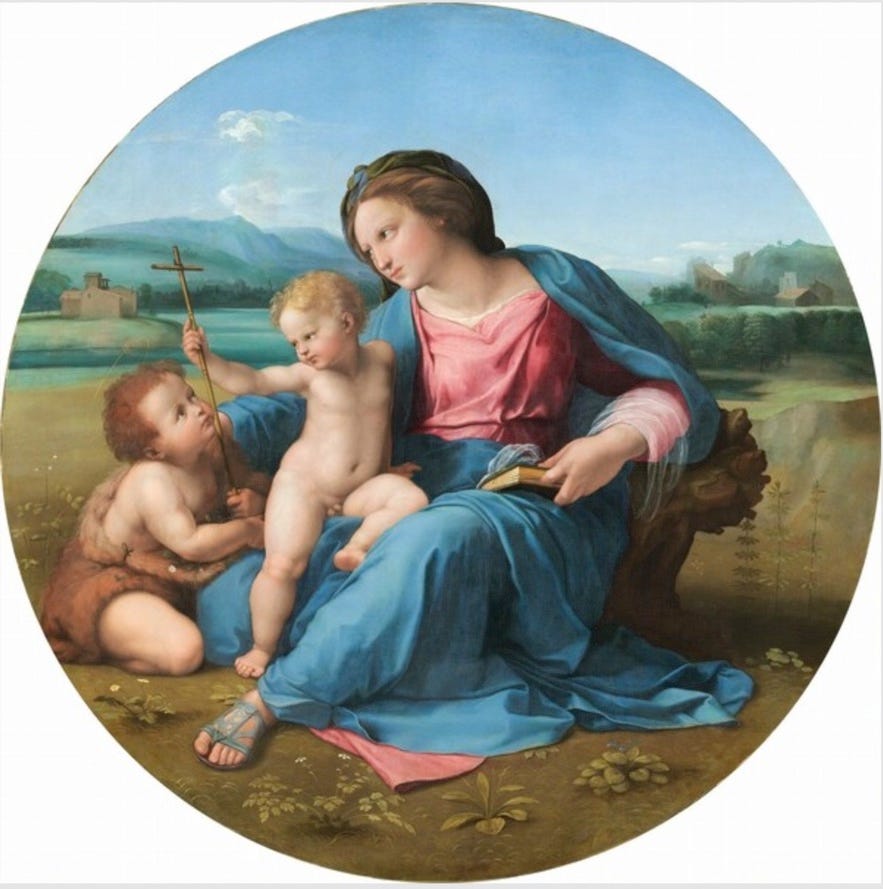
The Alba Madonna is in a special room in the National Gallery of Art. One has to weave through a number of other galleries to find it, but when one does… it’s like a meeting with Heaven on these earthly planes. Not to mention the perfect balance, the delicacy of line, the melding of a palette that is so harmonized in color that we scarcely could say we have ever seen something so spectrally perfect. All colors of the universe seem to be represented in the best of ways, and we can relax into a Peace of looking at this work that is far beyond our understanding, but undoubtedly palpable and present for us wholeheartedly through the grace of Raphael’s angelic genius.
On a couple of occasions, the painting was moved for whatever reason—perhaps renovations of the gallery, or on loan to another museum’s “special exhibition”—and I went through a kind of withdrawal in my deprivation of such beauty.
The babies in this picture, John and Jesus, are truly that. Their innocence and reality come forth. They are not “little men in babies’ bodies” as too often is the case in Madonna paintings by other Renaissance painters who attempted to paint Mary holding the baby Jesus. These two toddlers in this scene are the epitome of God’s gracefulness, completely convincing us of their “babyhood.” We can feel their synergy and the deep knowingness of the mission they are prepared to do together—beginning now in their absolute certainty.
You tell Raphael if you see him that this painting could go down as one of his best, though not as “well sung” in the annals of Art History as some of his Vatican scenes— like “The School of Athens,” or numerous exquisite portraits of the ruling class of his day—and such. But here we have his best brush forward in this Alba Madonna. The fact that it is round, brings all kinds of other powers to it. It transceds the conventions of the day, and enters into the realm of the sublime. It is like a vortex of miraculous manifestation, swirling in a spiral from the hand of a “painting angel,” giving us a glimpse of Life in the Heavenly Realms.
Why not? There are beings who have access to these visions beyond the good craft of their art, pushing through the transcendental portal to an application mere paint would never transmit by itself alone. The fact is their souls are there, in that Heavenly Reality of the formless, beyond the functions of the fleshly world we inhabit. They take us to where they abide, in the Spiritual Paradigm of Perfection we have never seen nor heard. Then they translate that Spritual Reality into paint. How do they do it but from the Gods Themselves?
They give us their vision, on a platter it seems, as in this case of this round impetus in the region of our Soul’s release. We are freed. We are lifted up. We are taken to heights of well-being we have hitherto never known—but now we do know. It’s right there in front of us, palpable in all its glory. A vision we can hold in our hearts and minds for the remainder of our days in this body’s life, be it ever long or short. Five seconds of seeing this “Nirvana of Visual Order” is worth one’s whole life.

Love is Forever
Right by my pics of the Alba Madonna in my 30,000 iPhotos was this snapshot of postage stamps. We have a kind of stamp that is classified “FOREVER.” This means if you purchased a stamp for 50¢s, and six months later the cost of that stamp went up to 58¢s, the stamp you bought at 50¢s would be FOREVER good to go, without any extra postage. Hence, FOREVER good in value, regardless of any postage price increases. Pretty good deal.
But now applied to this stamp LOVE, “forever” makes great sense. “Love is not love which alters, when it alteration finds.” says Shakespeare. LOVE is FOREVER, in other words, or it be a mere imposter, a substitute for the real eternal thing.
SONNET #116:
Let me not to the marriage of true minds
Admit impediments; love is not love
Which alters when it alteration finds,
Or bends with the remover to remove.
O no, it is an ever-fixèd mark
That looks on tempests and is never shaken;
It is the star to every wand’ring bark
Whose worth’s unknown, although his height be taken.
Love’s not time’s fool, though rosy lips and cheeks
Within his bending sickle’s compass come.
Love alters not with his brief hours and weeks,
But bears it out even to the edge of doom:
If this be error and upon me proved,
I never writ, nor no man ever loved.
—Shakespeare—
We could speculate about the time bound nature of relationships in our worldly domain, of the waxing and waning of political and influential forces, of the comings and goings of even huge empires, not more or less than the quickly fleeting changes of a fickle fashion—but when it comes to Love in the ABSOLUTE, “Love alters not with his [time’s] brief hours and weeks, but bears it out even to the edge of doom.”
Love is Forever, or it be not Love. Let’s aspire to that Love. The “FOREVER” kind.
A Contrast of Thorns and Roses
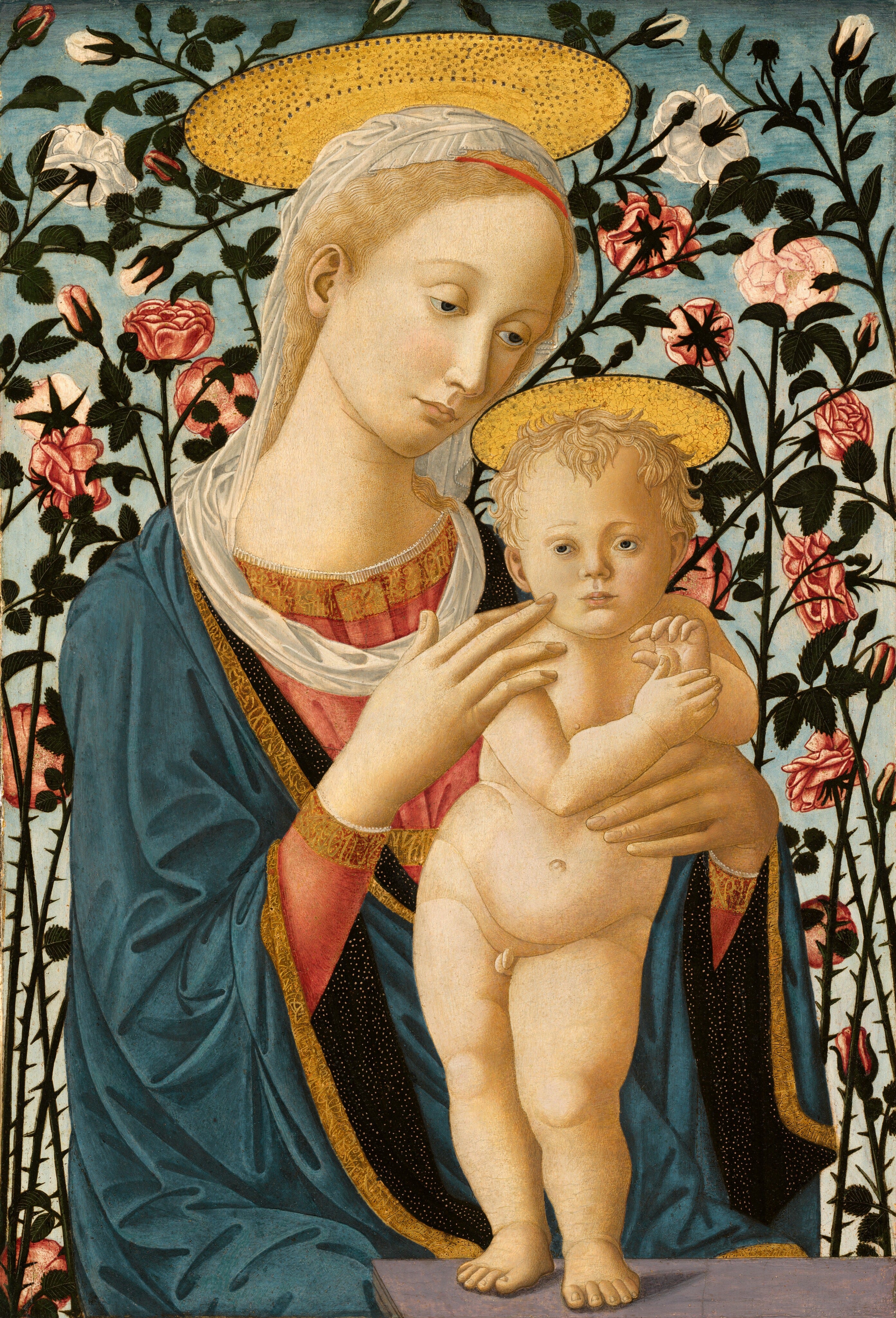
I always stop by this 15th century Italian painting of the Madonna. Not because it gives me a sublime encounter with the refined perfection of the Alba Madonna by Raphael, but because of its a daring and edgy use of an interlacing of roses, stems and thorns in the background. There is a clarity of line, and of a linear drawing mode that takes precedent over the painterly blends of chiaroscuro developed by later painters such a Leonardo, and further enhanced in the Mannerisms of Caravaggio and Tinteretto.
You can see what I mean when I said all too often the baby’s head of the Christ can suggest a more mature boy’s head on a baby’s body. This depiction is still in the time frame of a toddler, but not as gracious as Raphael’s Christ Child in the Alba Madonna. Early to mid 15th century Florence was the testing ground for the high Renaissance of the later years of the 15th century, leading into the early 16th century works of Leonardo, Raphael and Michelangelo, Titian, etc.
Before them we had Botticelli, Mantegna, in the mid 15th Century, and Giotto in the 14th Century. Italy was the seedbed of inovation. I suppose I like this Madonna because it would be more in keeping with the way I would paint it. It has a hint of the Northern Schools in it. The hard edged lines of the Belgian and German painters, the emphasis on a jewel like color almost compartmentalized, like stained glass windows, makes for a graphically powerful package. It is not feigning to be naturalistic. It is comfortable staying in the realms of the symbolic, the emblamatic, and even the heraldic. It uses a flattened version of layers—only three in this case: The Christ in the front; the Madonna in the middle; and the roses and thorns in the background. These layers are firmly kept and elegantly rendered to form a three tiered conjuction of the Mother and Child’s magnificence.
Peacock Feathers in our Living Room
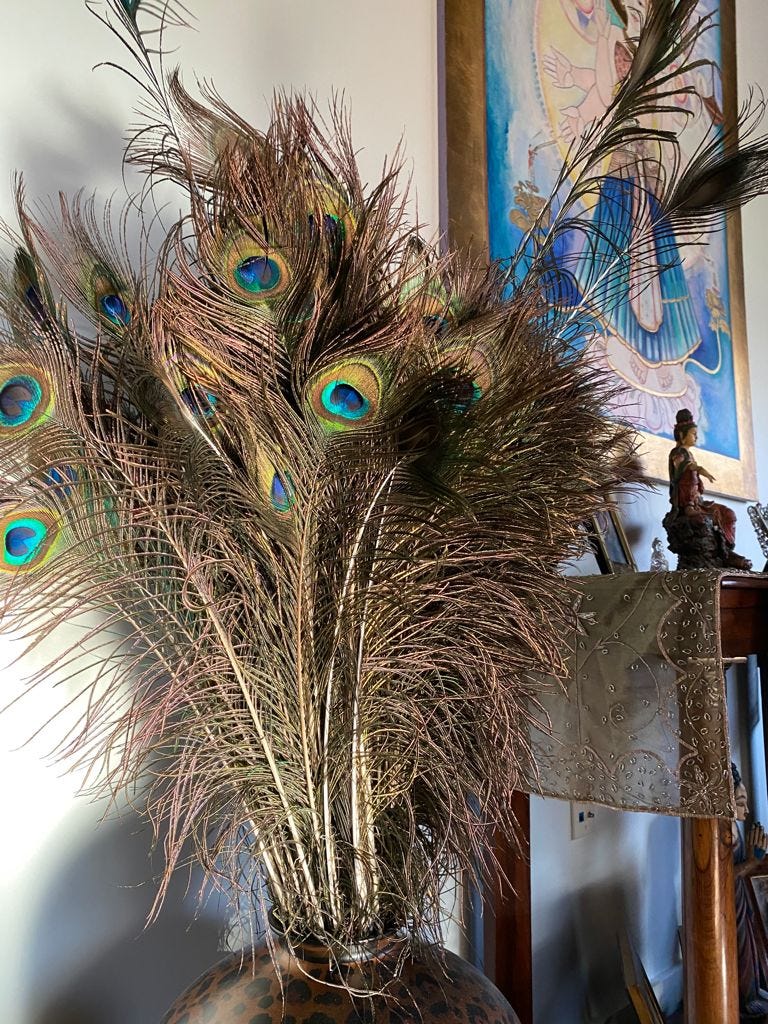
Every living room should not be without a vase of peacock feathers. They are considered elements of immortality, because the peacock is purported to be able to eat poison and not die. There is something about that “eye” of blue on a field of brilliant turquoise in the feathers that suggests a “light at the end of our blackened tunnel,” or a beacon of hope at the end of our long haul, through the dark night of our soul. Peacocks and their feathers give us an immortal burst of spiritual light that can wrest us away from any forebodings of doom and gloom.
It’s no accident we keep these right by our Divine Mother Altar. She blesses us with immortality, and the peacock feathers remind us of this. We are happy to have them around.
The Hand of Madame Moitessier by Ingres
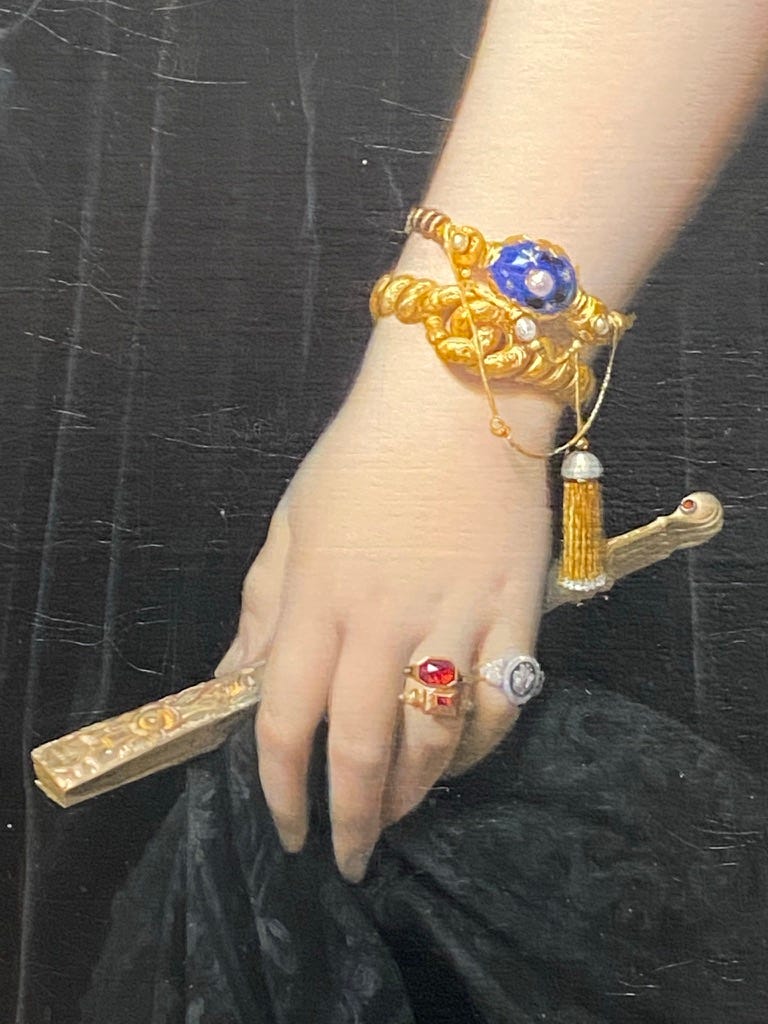
Ingres painted the high born and wealthy. Madame Moitessier, the wife of a Parisian financier, provided an imposing subject. This hand captures the whole stature of her poise and contenance. You need only see this hand to get her whole Presence. Such is the mastery of Ingres in paint.
Her hand is actually more beautiful than her face. She is imposing, and a bit formidable in her presence. As a man, I would not feel caressed or cuddled by her, yet something in her hand is more inviting, more facile and free, more caring and compassionate than her overall portrait in a black laced raiment.
Ingres does his usual “super detailed” perfectionism. Not that Madame Moitessier is void of elegance and beauty, but there is a “caution sign” that seems to whisper to us in the unseen details of her deportment. “Come close at your own risk.” Ingres gets this across in the most subtle of ways. I hope he got duly paid for the thing, considering his cautiously mood provoking honesty.
Have You Ever Seen Such an Orange?
I don’t know the painter, nor is it important that I do. I am not endeavoring to give you “art history.” I want to give you an Art Look. Honing your abilty to see, and to see something sublime, not merely being historically correct and well noted, requires to some degree I don’t really care about all the details—other than the ones that move you to a meeting with the actual of what is really there.
We do not need to “know” anything when we chance upon a snake. We will come to instant attention and head in the right direction. We don’t need to “know” anything when we see the bloom of a lily or smell its fragrance wafting throughout the atmosphere of our hearts. We are in the flow of its beauty and presence in our life. Instantaneously, we come upon it, and Life is ever unfolding in this fashion.
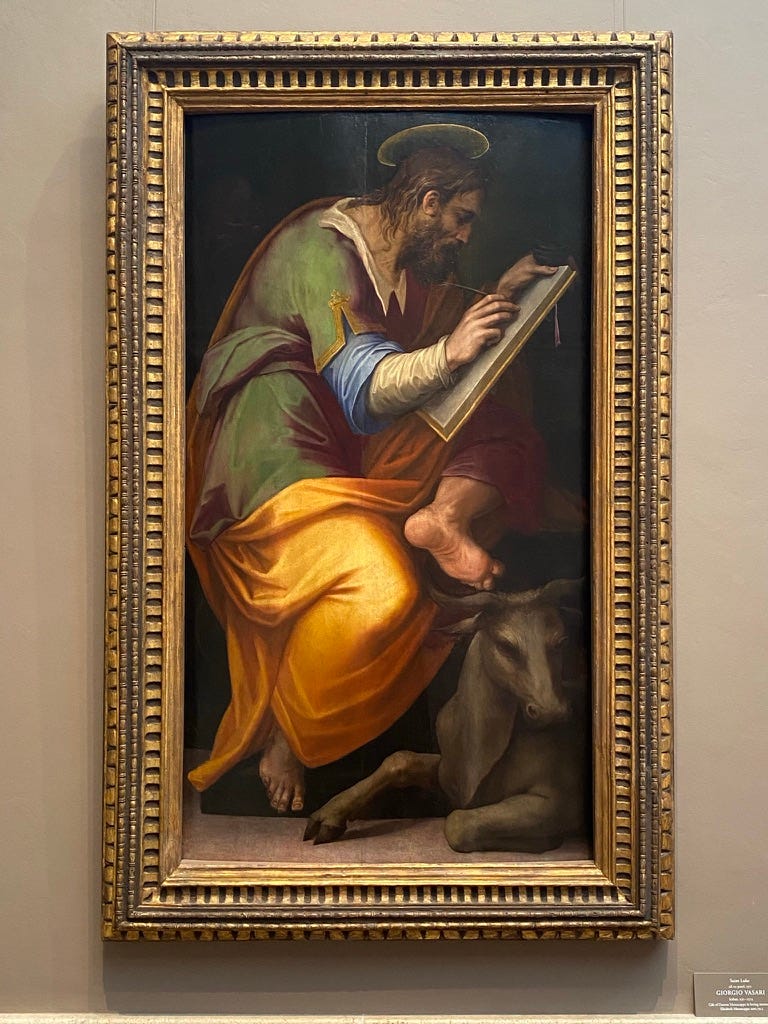
So I don’t need to “know” anything about this painting of an apostle, most likely Luke, scribing one of the gospels.
But what I do need to know is how do I feel seeing that Orange? Have you ever seen such a beautiful Orange? It almost “pops off the canvas” it is so luminous. It lights up our whole room of our heart with the warmth of Divine Love. The bull is a symbol of Luke, and the darkish, grayish umber of its hide sets off the Orange even more. And the olive green frock is the perfect compliment to the Orange. It sets it off like no other color can. Green and Orange are “Secondary Colors” with a common Yellow in between. They harmonize by virtue of this common Yellow on the Color Wheel.
Whoever painted this apostle scribing a gospel knew how color works, and made sure we “got it.” He woke up one day and said, “I am going to paint the holiness of Orange today.” And he did. And here it is.
Our Divine Mother Altar
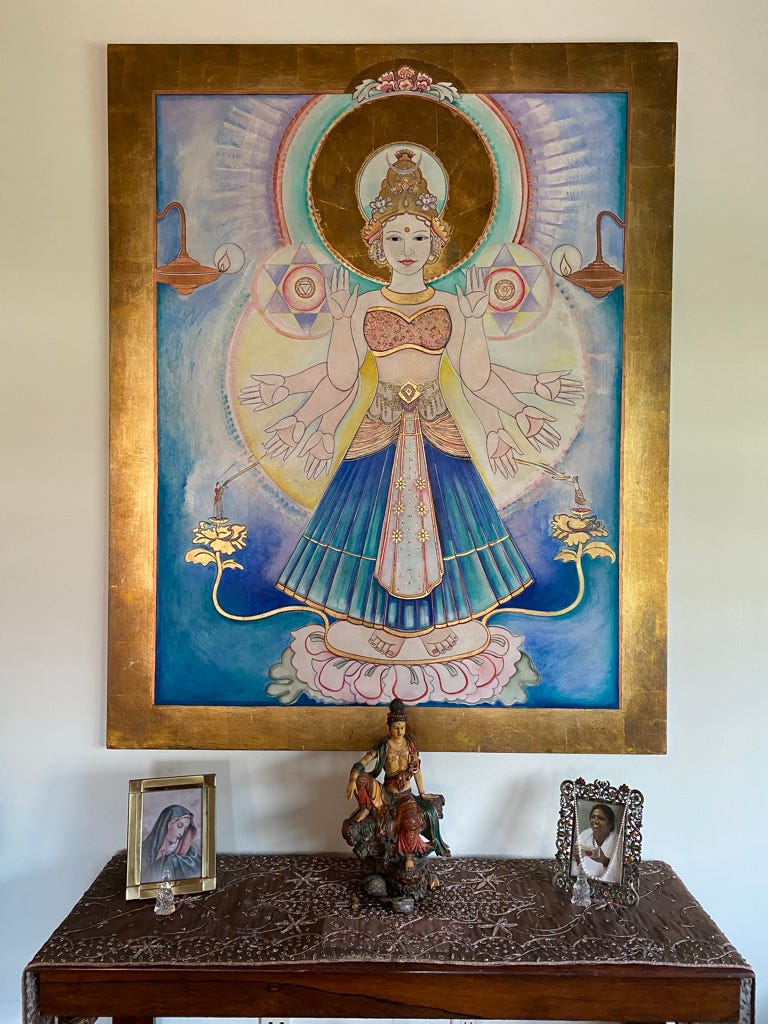
This painting by Naga Brand gives Energy out to the Universe, and mostly to us and through us, emanating out from our Universe. It abides in our Living Room. We live in it’s Presence and are blessed by it every day. There is nothing it’s Holiness cannot do when we ask of it to set us straight.
An Altar is a Relationship you set up to make contact with your Sacred Nature. There is a Divine Connection that comes about through attention paid to an Altar. Every home should have one, in our opinion. It gets us aligned with Higher Laws. It keeps us on the way of our souls to realize the Absolute in this lifetime, including the Absolute of our own Immortal Nature.
We “sit” in front of this Altar and empty our minds of our own agendas, and ask to be shown directions for our life. “What would you have me do? Where would you have me go? What would you have me say, and to whom?” The Divine Mother usually gives us the directions we need for the day. And it is a “Working Relationship” we have with Her as a result of sitting before Her Altar.
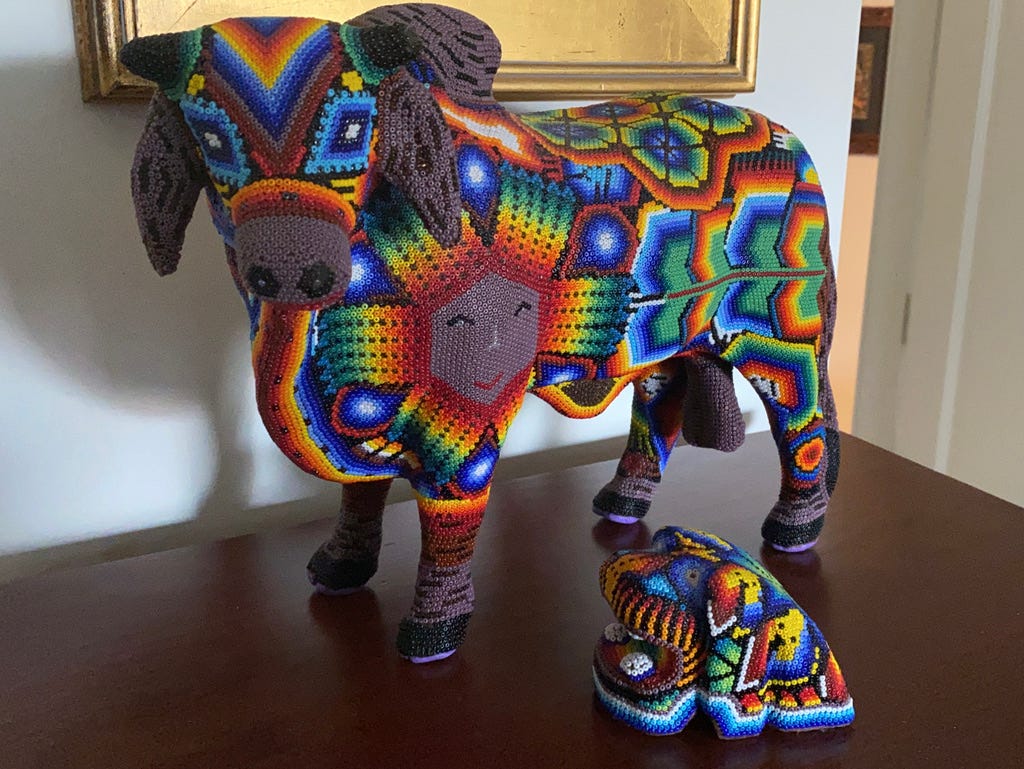
Huichol Beaded Bull from Mexico
A few years back we were speakers on a Cruise along the Pacific Coast of Mexico with some other Immortalists. We stopped off in Puerto Vallarta for a day, and walked in the town. There was a shop that sold these Huichol Indian’s beaded works of art, mostly on wooden sculptures of animal figurines.
First the animal is carved in wood, then coated with a thin layer of beeswax. Next, carefully and painstakingly, patterns of tiny little colored beads, each not even a millimeter wide, are pressed into the soft wax in incredible rainbow patterns of intricate geometry, and cover the contours of the form of the animal. The result is what you see below. This is a Brahma Bull we brought back from Puerto Vallarta. It is a Nandi, the transport of Shiva. I have it under a picture of Amma, the Divine Mother.
We need colorful things in our life. Color “picks up our spirits,” especially color that “hits us” in the gut, and gives us an experience of the rainbow. There is something powerful about the order of color in the natural frequency of the rainbow that is very healing. These Huichol Beaded Sculptures do that. They lift our Spirits into another dimension of Joy. Just look at this Bull for a minute and see what I mean. You will be “lifted up.” I guarantee it.
Paintings of the Life Force
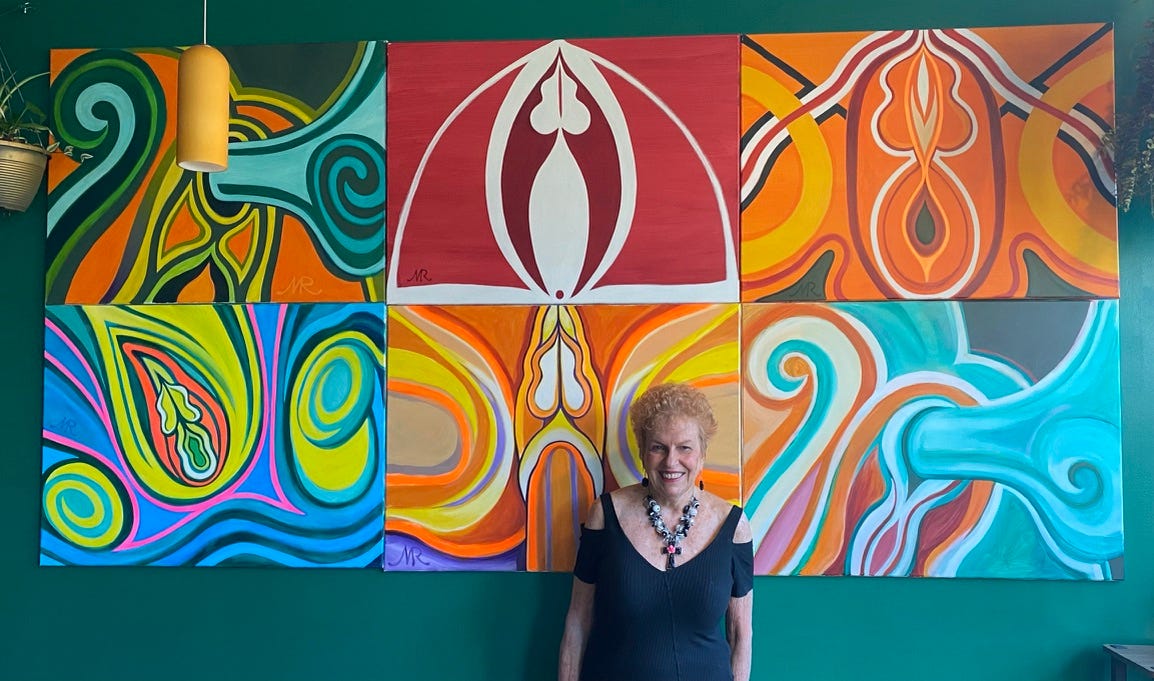
I am going to end with this Six Part Painting of The Life Force. You draw your own conclusions, and delve into it’s Presence and Meaning for you.
I painted it a few years ago.
May its Spiral of the Life Force give you a new birth of Freedom.
Remember, Random is not Random. Your Attention, earnestly given to this Present Moment, can find Beauty Everywhere. This Art Look was specifically composed with help of the Divine Forces—with You in mind. You are part of the Life Force as much, if not MORE, as any “work of art.” In fact, You are the “Ultimate Work of Art.” You are as God Created You, and God only creates Masterpieces. Just remember that. All Beauty resides in YOU!! You are an incarnation of Beauty Itself.
Bole Baba Ki Jai!
Love,
—MARKUS—